

Mole Rodent Control in Seattle: How to Hire and What to Pay
Mole rodent control in the Seattle area works when you hire a specialist who removes moles with underground devices, confirm they are licensed and insured, and get a written estimate before the first visit. For a typical residential yard, expect to pay a few hundred dollars. One local example is an In/Out service for a half acre or less, quoted at up to $395 before sales tax.
The trouble is that moles are not rodents, and many general pest companies treat them like rats. Rodent bait gets ignored, store-bought fixes fail, and fresh mounds keep appearing while your lawn gets worse. Hiring the wrong provider costs you weeks and money.
This guide walks you through four steps: confirm the animal, vet local providers, compare estimates, and prepare for the visits and follow-up. It draws on how Mole Masters, a mole-only company serving King and Pierce counties since 1991, runs its jobs. You get real numbers and a real process to measure other quotes against.
Why mole rodent control is its own trade
Moles need a specialist because they are not rodents, and the tools made for rats and mice do not work on them.
Moles are not rodents
Moles are insect-eating mammals , not members of the rodent family. In western Washington the usual culprits are the coast mole and Townsend's mole. Both feed mostly on earthworms and grubs , which is why damp lawns around Seattle, Issaquah, Puyallup and Gig Harbor attract them.

That changes how you treat them. Grain bait and snap traps meant for mice never interest a mole. A company that mainly sells rodent service may not own the right devices or know where to place them.
Moles eat worms, not grain, so rodent bait never reaches them.
Why store-bought fixes disappoint
Many Mole Masters customers have already tried in-store products, poisons or bait before they call. Those products rarely solve the problem, and poisons add risk for pets and children. What works is a device set inside an active tunnel, and placing it well takes practice.
Step 1. Confirm you have moles
Look for volcano-shaped mounds of loose soil. They are the clearest sign you have moles and not another burrowing animal.
Signs that point to moles
Check your yard for these:

- Round, cone-shaped mounds with no open hole on top
- Raised ridges of soil running across the lawn, where a tunnel sits just under the surface
- New mounds that appear overnight, especially after rain
Fan-shaped mounds with a plug off to one side suggest a pocket gopher. Surface runways and gnawed plants suggest voles. A mole-only company will tell you honestly if your problem is something else, which a general provider may not.
Gather details for the estimate
Take photos of the mounds and ridges, and note roughly how many fresh mounds you see and where. Write down your lot size, how long the activity has gone on and anything you have already tried. A provider can quote you far more accurately with that information.
Photos and a lot size let a provider quote you accurately before anyone visits.
Step 2. Find and vet local mole specialists
Hire a company that handles moles every day, is licensed and insured, and answers your questions plainly.
Where to look in your area
Search for mole removal plus your city, such as Seattle, Puyallup, Gig Harbor or Issaquah. Read recent reviews on Google, Yelp and Facebook, and ask neighbors who had the same problem. Look for reviews that describe the whole job, not just the first visit.
Then confirm the company serves your address. Mole Masters covers about 50 cities across King and Pierce counties, and if you are unsure about yours, the office will look it up when you call.
Questions to ask before you hire
Ask every provider these seven questions:
- Do you handle only moles, or many pests?
- Are you licensed and insured, and can you show proof?
- What method do you use, and does it involve poison?
- How many visits do you plan, and on what schedule?
- Do you charge extra for each mole caught?
- What happens if moles are still active after the last visit?
- Who cleans up mounds and repairs the lawn?
Here is how Mole Masters answers. It does only moles, has done so since 1991, is licensed and insured, and uses no poisons or chemicals. Its devices have hard plastic covers and are staked down. It charges nothing extra per mole. It does not generally clean up molehills or repair lawns, so plan to rake the soil yourself or hire a landscaper.
A provider who answers all seven questions plainly is usually the one worth hiring.
Step 3. Compare estimates and mole control cost
Get at least two written estimates, then compare the worst-case total, the number of visits and what is included, not just the headline price.
How providers price the work
Pricing models differ a lot, and the model matters as much as the number.
| Pricing model | How it works | What to check |
|---|---|---|
| Flat package | One price for a set number of visits | What happens if the job ends sooner |
| Per visit | You pay for each trip | The total if the job runs long |
| Per mole | A fee for each animal caught | The total is open-ended |
| "Up-to" quote | A maximum price that drops if the job is easier | Whether the discount is in writing |
| Ongoing plan | Spread-out visits over months | Contract length and cancellation |
Ask each company for the worst-case total in writing. Moles are unpredictable, and a quote that cannot be capped is a risk to you.
A worked example
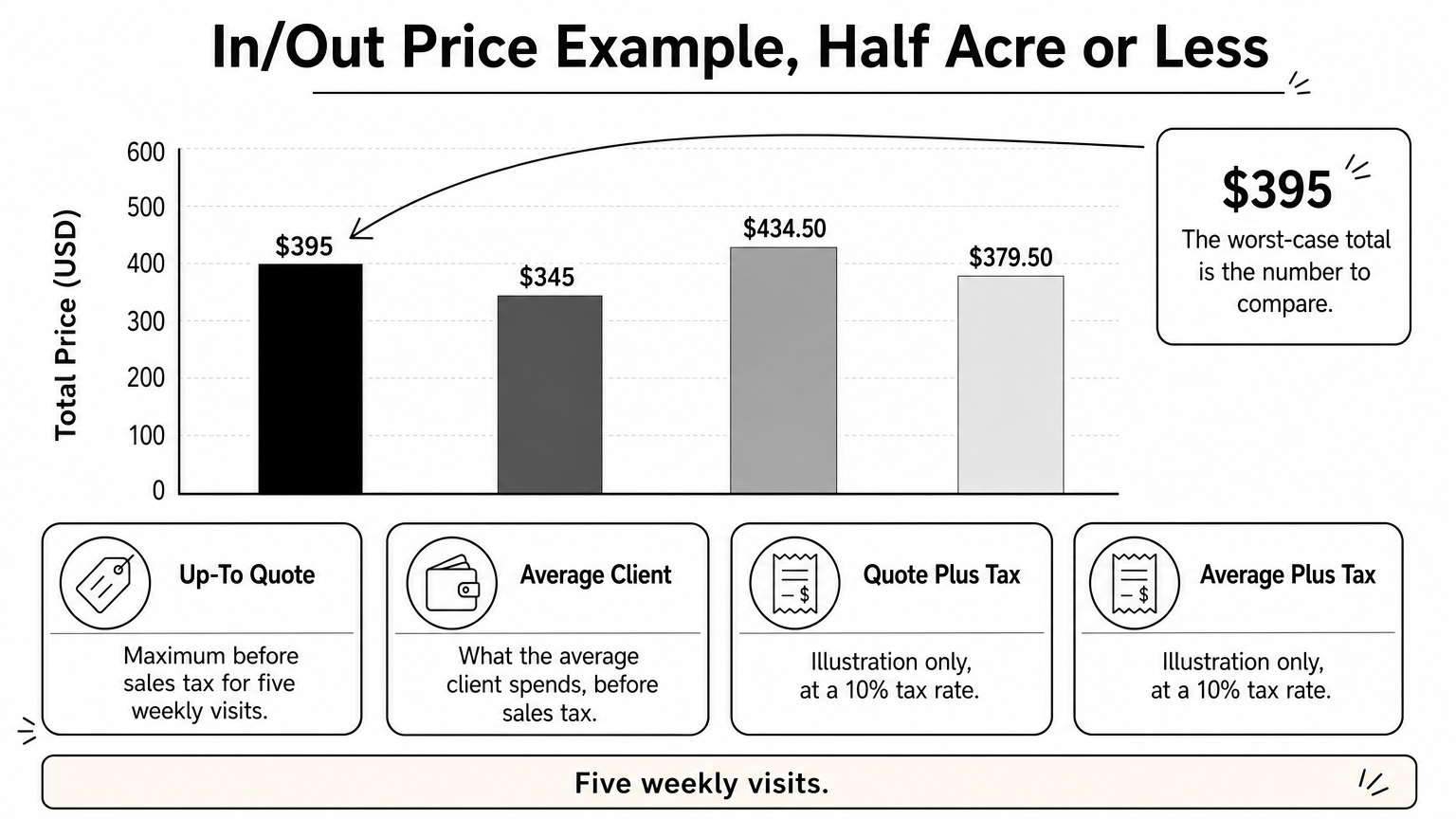
Take a typical suburban lot of half an acre or less. Mole Masters quotes its In/Out service at up to $395 for five weekly visits, and its average client spends $345 . Sales tax is extra. As an illustration, at a 10% tax rate the ceiling becomes $434.50 and the average becomes $379.50.
Larger properties and harder locations can change the figure. If the technician can pull out early, you get a discount on a sliding scale. The quoted figures are published numbers, so confirm the current rate when you request your free estimate.
The number to compare is the worst-case total, not the first price you hear.
Step 4. Prepare for the visits and prevent a return
Plan on about five weekly visits, leave the devices alone, and choose follow-up service only if moles keep coming back.
What the visits look like
In Mole Masters' In/Out service, each visit assesses the yard, adjusts the setup if needed, and ends with a summary of what is happening on site. Most clients need five trips or fewer, but some need more. Extra devices or visits can be added to suit your yard.
Keep children and pets away from the staked devices, and do not move them. Ask your technician before you rake mounds, because fresh soil shows which tunnels are still in use.
Pick the right follow-up
Once the active problem is controlled, you can end the service or move to a longer-term option.
| Service | Best for |
|---|---|
| In/Out Mole Control | An active problem you want gone |
| Tunnel Clear Application | Clearing and repairing tunnels so other pests do not move in |
| Preventative Mole Control Application | Stopping infestations before damage starts |
| Year Round Mole Control | Constant mole pressure and ongoing monitoring |
Mole Masters recommends year-round service only if you need maintenance for longer than eight months, and it does not generally suggest starting there. Commercial properties such as parks, HOA grounds and office lawns are assessed through the office rather than with an online estimate.
Start with a short, focused job and add maintenance only if moles keep returning.
Getting your lawn back
Good mole control starts with the right provider. Confirm you have moles, hire a licensed, insured specialist who does not rely on poison, compare worst-case totals, and follow the visit schedule. Skip rodent bait and general pest contracts, because moles eat worms and need a different approach.
If you live in Seattle, Gig Harbor, Puyallup, Issaquah or elsewhere in King or Pierce County, you can request a free estimate from Mole Masters by form, email or phone at (253) 926-0402. The office is open Monday to Thursday 9am to 5pm and Friday 9am to 3pm.