

Mole Control Castor Oil: Does It Work and How to Apply It
Mole control castor oil works as a mild repellent at best, so treat it as a cheap three-week test and not a cure. Mix 6 ounces of pure castor oil and 2 tablespoons of dish soap into 1 gallon of water, soak the soil where you see fresh mounds, and repeat every two weeks. If new mounds keep appearing after three weeks, the oil is not working on your yard, and it is time for traps or a professional.
The problem is that the claims are loud and the results are mixed. Store shelves carry castor oil granules and sprays with bold labels. Forum posts swing between "my lawn has never looked better" and "it did nothing." Meanwhile a mole can push up several mounds overnight. University extension guidance describes castor oil products as only minor in effectiveness.
At Mole Masters, we have done nothing but mole control in the Puget Sound region since 1991, and many of our customers tried store-bought products before they called us. This guide walks you through four steps: confirming you have moles, mixing or buying a repellent, applying it correctly, and judging the results so you know when to stop spending money on it.
Does castor oil actually get rid of moles?
No, not reliably. Castor oil does not kill moles or pull them out of a yard, and at best it makes the soil less appealing for a while.
What castor oil does in the soil
Moles eat earthworms and grubs, not roots or bulbs, which is why they ignore grain-style baits. The theory behind castor oil is that it leaves the soil and the worms in it unpleasant to taste and smell . A mole then moves its hunting somewhere else. The oil poisons nothing and traps nothing.
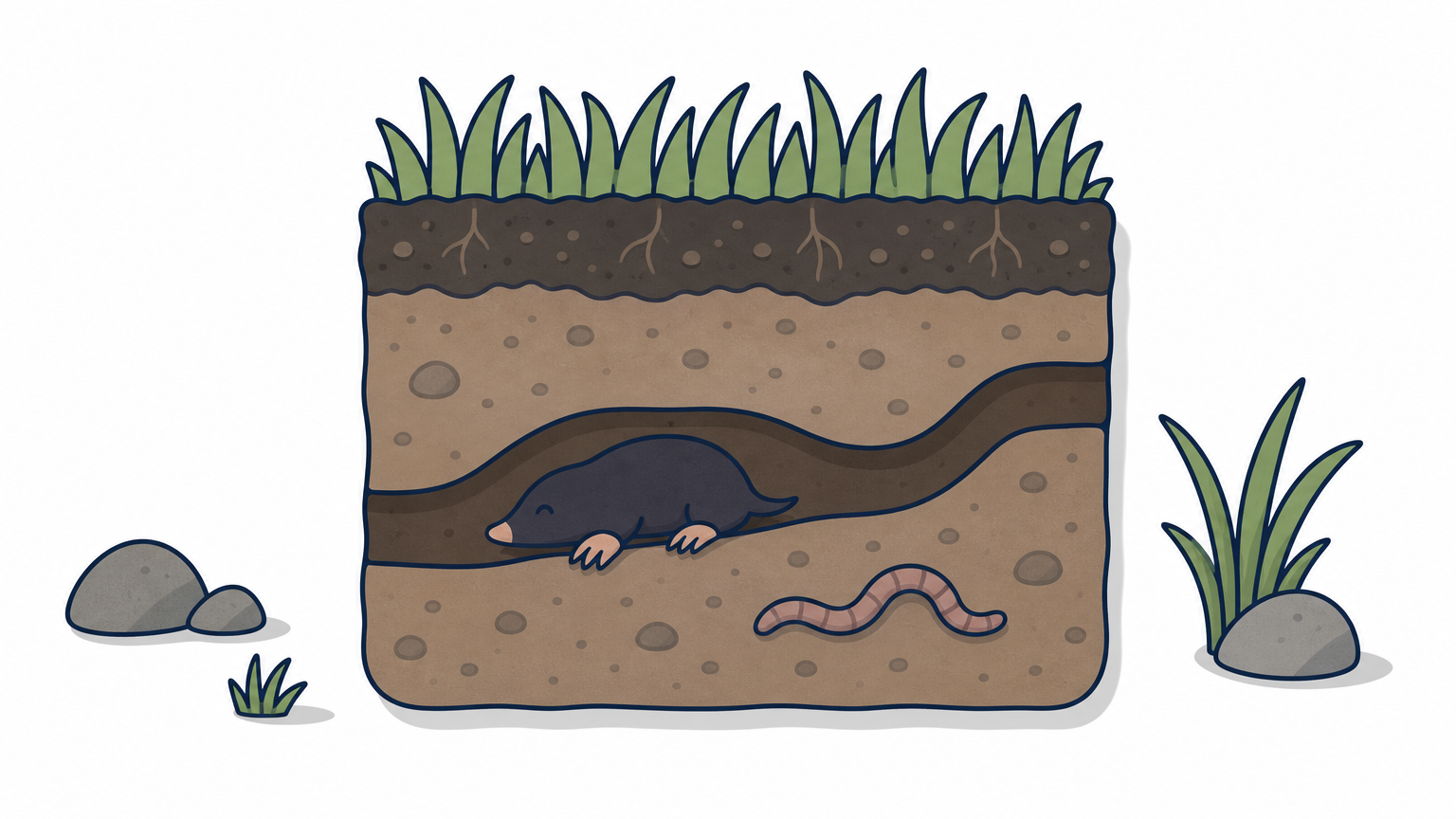
The weak point is depth. A drench only reaches the top few inches of soil , while moles also run deeper tunnels that a sprayer never touches. A mole can hunt below the treated layer or cross the lawn to untreated ground.
What the evidence says
Nebraska Extension lists castor oil products, commercial ones included, as showing minor effectiveness against the eastern mole. That is a long way from proof that it clears a yard. Western Washington has different species, mainly Townsend's and coast moles, so even that modest result may not carry over.
Lawn owners report both outcomes. Some say the oil saved their lawn, and others saw no change. Both can be honest, because moles shift territory with soil moisture and food on their own. You cannot tell from one yard whether the oil worked or the mole simply moved on.
When it is worth trying
Castor oil earns a try in narrow cases:
- You see one to three fresh mounds, not dozens.
- The lawn is small enough to soak with a hand sprayer.
- You want to avoid poisons around kids and pets.
- You can accept a three-week test with no guarantee.
Skip it when mounds are multiplying, when you manage a large lawn or commercial grounds, or when the damage is already severe.
Castor oil and mole control go together only as a cheap experiment, never as a guaranteed fix.
Step 1. Confirm moles and mark active tunnels
Before you mix anything, confirm that moles are the problem and flag the tunnels they still use. Both jobs take about 15 minutes, and together they give you the baseline you need to judge the repellent.
Confirm the culprit
Many castor oil products are sold for moles, voles and gophers, but the three leave different signs. Check this table before you treat.
| Pest | What you see |
|---|---|
| Mole | Round, volcano-shaped mounds of loose soil with no visible hole, plus raised ridges across the lawn |
| Pocket gopher | Fan-shaped or crescent mounds with a plugged hole off to one side |
| Vole | Shallow runways in the grass and small open holes, but no mounds |
Ridges and cone-shaped mounds mean moles. If you see runways without mounds, you are dealing with voles, and this guide will not fit.
Flag the active runs
Moles abandon tunnels, so not every mound needs treatment. Mark the live ones this way:
- Press down each raised ridge and flatten each fresh mound.
- Push a survey flag or stake next to every spot you flattened.
- Check again after 24 to 48 hours. A spot that has been pushed back up is active.
- Count the new mounds each day for one week and write the number down.
That count is your baseline. Without it, you will not know whether a quiet lawn in week three is thanks to the oil.
A mole count before treatment is the only way to know whether the oil did anything.
Step 2. Mix your own or buy a ready-made product
Mix your own if you want the cheapest test. Buy ready-made if you want consistent strength and a spreader instead of a bucket. Both rest on the same ingredient, so neither one carries stronger evidence.
The DIY castor oil mole repellent recipe
The common home recipe uses 6 ounces of pure castor oil and 2 tablespoons of dish soap per gallon of water . The soap works as an emulsifier. Without it the oil floats and clogs your sprayer. Buy plain castor oil, not a fragranced or blended cosmetic product.

| Batch size | Castor oil | Dish soap |
|---|---|---|
| 1 gallon | 6 oz (¾ cup) | 2 tbsp |
| 2 gallons | 12 oz (1½ cups) | 4 tbsp |
| 3 gallons | 18 oz (2¼ cups) | 6 tbsp |
| 5 gallons | 30 oz (3¾ cups) | 10 tbsp |
To mix a batch:
- Combine the oil and soap in a bucket and whisk until the mix turns milky.
- Add the water and stir.
- Pour the mix into a pump sprayer or a hose-end sprayer.
When a ready-made product makes sense
Ready-made granules and concentrates usually blend castor oil with other plant oils. They suit larger lawns because a spreader covers ground faster than a pump sprayer. Check the label for the castor oil percentage and the application rate , and follow the printed rate, not the DIY recipe.
Do not expect better odds from the bag. The extension rating of minor effectiveness covers commercial castor oil products too, so spend as little as you can on the test.
Ready-made or homemade, the oil is the same, so keep the cost of the test low.
Step 3. Apply the repellent and repeat on schedule
Soak the soil across the whole affected area plus a buffer, then reapply every two weeks and after heavy rain. A single application that you never repeat tests nothing.
How to apply it
Follow these steps for each treatment:
- Apply when the soil is damp, after rain or after a light watering, so the oil moves down into the soil.
- Wear gloves and shake the sprayer often, because the mix separates.
- Cover every spot you flagged plus a buffer of about 10 feet around them. Tunnels branch , so treating only the mounds misses most of the network.
- Open the top of a fresh mound and pour a generous splash straight into the tunnel.
- Keep pets and children off until the lawn dries, and keep the mix off concrete and pavers, where oil can stain.
A schedule for Puget Sound weather
Rain washes oil out of the top layer, and lawns around Seattle and Tacoma stay wet for much of the year. Plan on a fresh treatment every two weeks and after any heavy rain . Moles stay active all year in western Washington and push up the most mounds when the soil is soft in spring and fall. Run your test in that season if you can, because a quiet lawn in dry weather proves nothing.
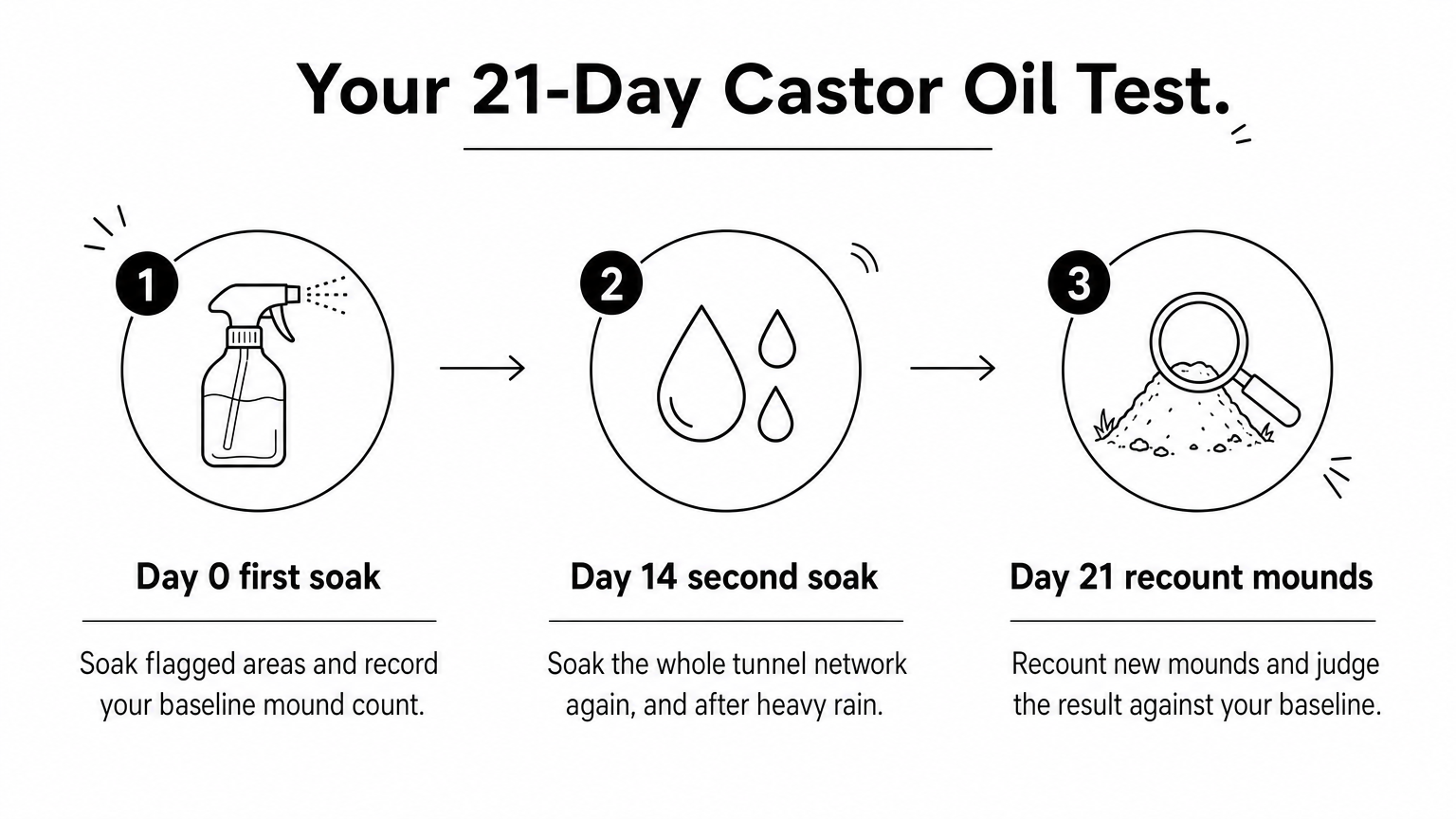
- Day 0: first soak, flags in place, baseline count recorded.
- Day 14: second soak.
- Day 21: recount new mounds and judge the result.
Treat the whole tunnel network on a fixed schedule, or you are not testing the oil at all.
Step 4. Judge the results and know when to call a pro
At day 21, compare your new-mound count with your baseline. If mounds still appear at the same pace, stop treating and change methods.
Read your results
Use this table to decide what happens next.
| Result at three weeks | What it likely means | Next move |
|---|---|---|
| No new mounds, flagged ridges stay flat | The mole left, possibly because of the oil, possibly on its own | Reapply monthly and keep counting |
| Fewer new mounds | A partial effect, or a mole drifting away | One more two-week cycle, then recount |
| Same or more mounds | The oil is not working | Stop, and switch to trapping or a professional |
Do not jump to poison bait if the oil fails. Moles feed on worms and grubs, so grain-style baits are a poor fit, and any bait adds a risk to pets and wildlife .
When to call Mole Masters
If you live in King or Pierce County and the repellent failed, we can take over. We control moles with underground devices, without poisons or chemicals . The devices are covered with hard plastic and staked down, so they are safe around kids and pets. Most clients finish within our five-trip In/Out system, with weekly visits, and some need more.
You get a free estimate with an "Up-To" worst-case price. The listed Up-To figure for a half acre or less is $395, and our average client has spent $345, before sales tax. The price drops if the job takes fewer visits or turns out easier than expected, and we do not charge extra per mole caught.
If the mound count has not dropped in three weeks, more castor oil will not change it.
Test it once, then move on
Castor oil is a low-cost, low-odds repellent. Count your mounds first, mix 6 ounces of oil and 2 tablespoons of soap per gallon, soak the whole tunnel network every two weeks, and judge the result at day 21. If fewer mounds appear, keep going for a while. If nothing changes, you have your answer, and you have not lost much time or money.
When the mounds keep coming, a professional will save you weeks of guessing. Request a free estimate from Mole Masters by form, phone or email, and we will tell you the most you could pay before any work begins.