

5 Ways to Get Rid of Moles from Your Garden, Ranked
The most reliable way to get rid of moles from your garden is to trap them, either yourself or through a mole-only professional. Repellents, castor oil and kitchen remedies work far less often, and changing how you water only tilts the odds. The five methods below are ranked by how reliably they end a problem. A professional suits large or repeat-offender yards. DIY traps suit patient owners of small yards. Wire barriers suit a few precious beds. Repellents suit very light problems, or owners who don't want to kill anything.
Moles don't eat your plants, but their tunnels lift turf, expose roots and leave mounds that dull mower blades. Every week you wait, the tunnel network grows. Most online advice lists a dozen folk remedies and never says which ones fail. This article tells you what to expect from each method, what it costs in money and effort, and who should skip it.
We are Mole Masters, a family-run company that has done nothing but mole control around Seattle and Tacoma since Nick founded it in 1991. What follows comes from that hands-on work in wet Puget Sound soil, where moles stay active all year.
1. Hire a mole-only professional
How it works
Our In/Out Mole Control starts with a thorough yard inspection. Then underground devices go into active tunnels, with no poisons or chemicals. Each device sits under a hard plastic cover and is staked down, so pets and kids can't reach it.
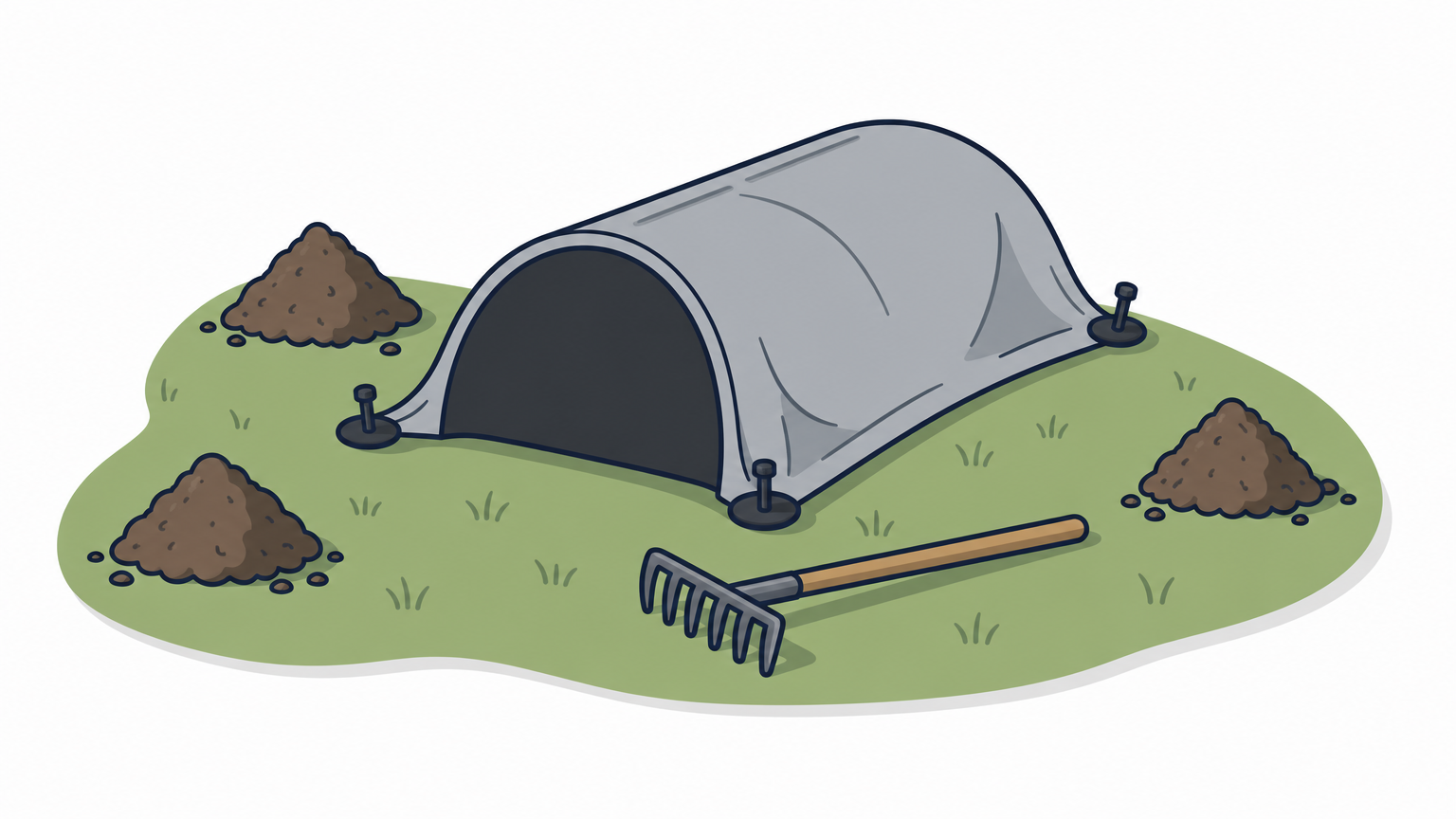
A technician returns about once a week. Each visit assesses what the moles did, adjusts the setup if needed and ends with a summary of what is happening on site. Most clients need five trips or fewer, though some yards need more.
Finding the active tunnels is the whole job, and that skill comes from years of practice.
Who it suits
This route fits large or repeat-offender yards , commercial grounds, and anyone who has already tried store-bought poisons or bait without luck. It also suits you if you can't check traps every day.
One limit: we don't generally clean up molehills or repair lawns, so plan to rake the mounds yourself afterward. We serve King and Pierce counties. If you aren't sure about your address, call the office and we'll look it up.
Cost and effort
- Price: "Up-To" $395, the worst-case quote for a property of half an acre or less on the five-visit weekly system. Our average client spends $345, before sales tax.
- Early finish: if we can pull out early, the price drops on a sliding scale. We never charge extra per mole caught.
- Larger or harder properties: these can change the estimate, so ask for the free quote by form, email or phone at (253) 926-0402.
2. Trap the moles yourself
How it works
First confirm the culprit. Moles push up round, cone-shaped mounds of loose soil and leave raised ridges just under the turf. Gophers leave fan-shaped mounds, and voles often use tunnels that moles dug. Then find an active run and set the trap:
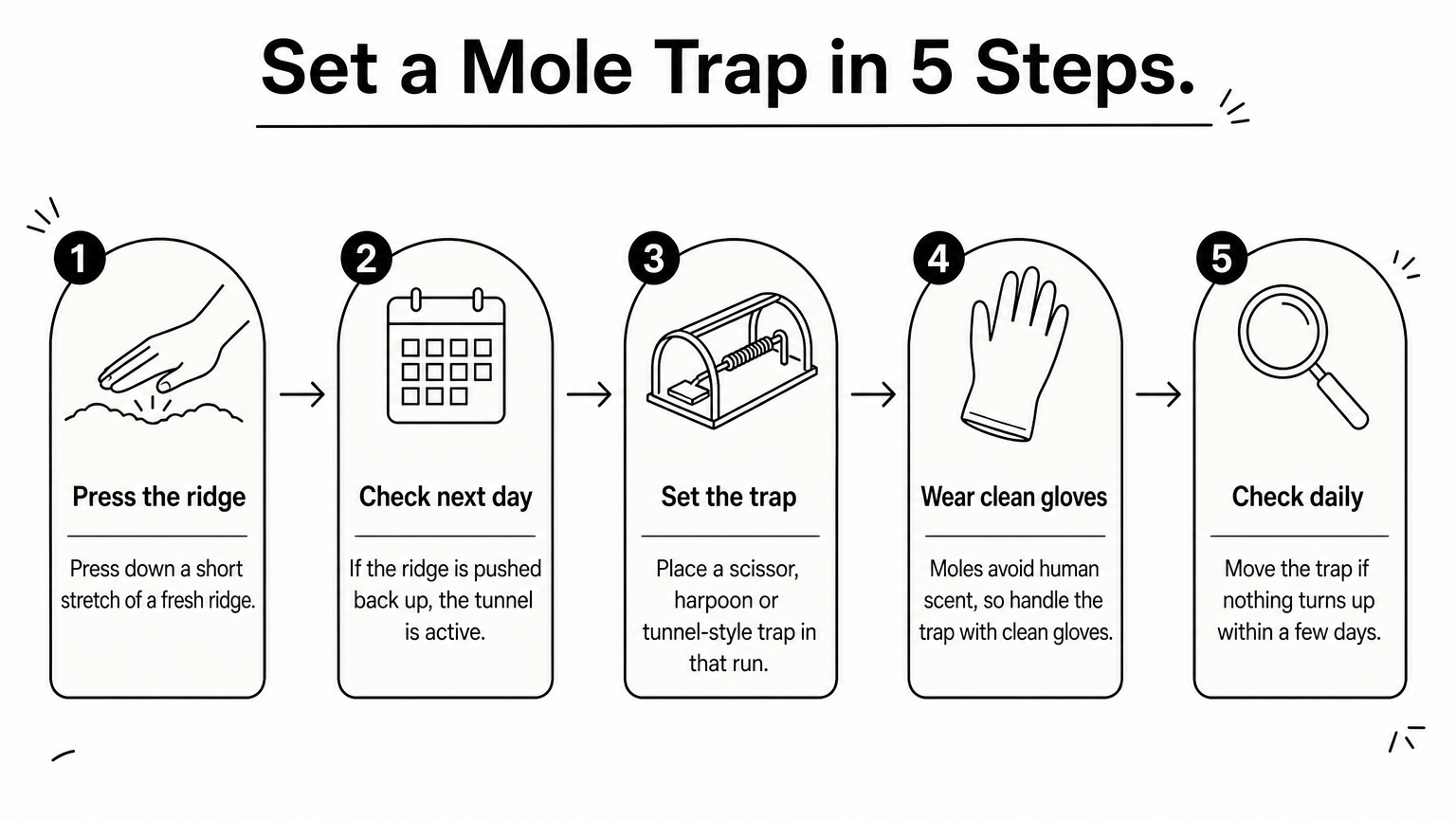
- Press down a short stretch of a fresh ridge.
- Check it the next day. If it has been pushed back up, the tunnel is active.
- Set a scissor, harpoon or tunnel-style trap in that run, following the package directions.
- Handle it with clean gloves, because moles avoid human scent .
- Check daily, and move the trap if nothing turns up within a few days.
A trap only works in an active tunnel, so test the ridge before you set anything.
Who it suits
This method suits patient owners of small to medium yards who are comfortable handling a dead animal. Most common mole traps kill, so check what trap types your state and local rules allow before you buy.
Live capture is possible, but moles can't go long without food, so a live trap needs frequent checks. Relocation also rarely works well, because moles are territorial and a released mole may be attacked.
Cost and effort
Traps are usually a modest one-time purchase. The real cost is time: daily checks, and often several traps for one yard. Expect days to a couple of weeks , not overnight.
Know the limits as well. Removing one mole doesn't stop a neighbor's mole from drifting into the empty ground, which is why some owners end up trapping every season.
3. Fence off beds with wire barriers
How it works
Bury hardware cloth , a galvanized wire mesh, around the area you want to protect. Go about 2 feet deep and bend the bottom edge outward in an L, so a mole tunneling toward your plants hits the wire and turns away.

This is the closest thing to a permanent fix , because it doesn't depend on winning against every mole. It only protects the space it encloses, though.
A barrier protects the ground it surrounds, and nothing else.
Who it suits
Barriers suit vegetable plots, raised beds and prized flower borders, meaning small, clearly bounded areas. They are a poor fit for a whole lawn. Trenching 2 feet deep around half an acre is impractical, and trapping handles that job better.
Cost and effort
Material cost scales with the perimeter, and the labor is heavy but happens once. For a 4 by 8 foot bed, the perimeter is 24 feet. You would need about 24 feet of mesh roughly 3 feet wide, covering the depth and the outward bend, plus a little extra to overlap the seams. A weekend and a sharp spade is a fair estimate.
4. Try repellents and home remedies
How it works
Repellents try to make soil unpleasant through smell, taste or vibration. Moles tend to tunnel around them or leave only briefly, so results are mixed at best. Here is what to expect from the usual suspects:
| Remedy | What people claim | What to expect |
|---|---|---|
| Castor oil products | Make worm-filled soil unappealing | Mixed reports, and rain washes it out |
| Coffee grounds, mint or eucalyptus oil | A strong smell drives moles off | Little evidence, and moles dig around it |
| Vibrating or sonic stakes | Vibration signals danger | Moles may leave briefly or get used to it |
| Mothballs, hair, razor blades, gum, pinwheels | Folk remedies | Not reliable, and mothballs are a pesticide risk for kids and pets |
| Dish soap or vinegar drenches | Flush or sicken moles | No dependable results, and can stress the soil |
The more a remedy sounds like a kitchen shortcut, the less likely it is to hold up.
Who it suits
Try these only if your problem is very light , you want a no-kill approach, and you accept low odds. They also make sense as a cheap test while you decide on something firmer. Keep mothballs out of the soil entirely.
Cost and effort
Most of these cost a few dollars. The catch is repetition: after a heavy Pacific Northwest rain, castor oil and scent treatments need reapplying. If you see fresh mounds a week after treating, stop spending and move up this list.
5. Cut the food supply and repair tunnels
How it works
Moles hunt earthworms, grubs and insect larvae. They don't eat plant roots or bulbs. Soggy, worm-rich soil attracts them, so water deeply but less often and let the top layer dry between sessions. This makes your lawn a little less appealing. It won't evict a mole that is already settled.
Root damage usually comes from tunnels leaving air gaps, or from voles using the runs. That is why repairing tunnels matters.
Habitat changes won't remove a mole, but they make every other method work better.
Who it suits
Everyone, as a support step alongside trapping or a professional service. It matters most if your yard stays damp from autumn through spring, when moles are most active. If other rodents keep using the old runs, our Tunnel Clear Application clears and repairs the tunnels so they stay undisturbed.
Cost and effort
This costs nothing but a rake. Flatten ridges, press down tunnels, rake mound soil into beds or compost, and reseed bare patches. Fresh mounds then become your progress report . If none appear for a couple of weeks, your method is working. For yards hit every season, ask about our Preventative Mole Control Application or Year Round Mole Control.
What to do first
Start with the reliable options. Trap them yourself if your yard is small and you have the patience, or hand the job to a mole-only professional if the yard is large or the moles keep returning. Protect special beds with wire, treat repellents as a cheap long shot, and use watering and tunnel repair to support whatever you choose.
If you'd rather skip the daily trap checks, request a free estimate from Mole Masters by form, email or phone. You'll get an "Up-To" price with no surprises.