

Vole Mole Control: How to Identify, Treat and Hire Help
Effective vole mole control starts with a 24-hour check to learn which animal you have, followed by a method matched to it. For moles, that means legal underground trapping. For voles, it means cutting cover and using snap traps. A local pro makes sense for moles, and a standard half-acre job with Mole Masters tops out near $395 before sales tax.
The trouble is that mounds, ridges and dead patches look alike from the kitchen window. You buy a bag of mole killer, the damage keeps coming, and the real culprit turns out to be a different animal, or both at once. Wet Pacific Northwest soil keeps worms close to the surface, so moles dig hard from fall through winter. Voles then move into the open tunnels. Many of our customers tried store-bought products, poisons or bait before they called us.
This guide walks through four steps: identify the animal, pick methods that work, hire and budget for a pro, and follow up so the problem stays fixed. We are a family-run company that has done only mole control around Seattle, Tacoma and the rest of Puget Sound since 1991. That means we are upfront about where voles are a different job.
Why moles and voles need different fixes
Moles and voles leave similar-looking damage, but they eat different food, so one product rarely solves both. A mole hunts worms and insects. A vole is a plant-eating rodent. Pick the wrong tool and you pay for it twice.
Two animals, two kinds of damage
Moles spend almost their whole lives underground and eat earthworms, grubs, slugs and other invertebrates. West of the Cascades the main species are the Townsend mole, which at 8 to 9 inches is the largest mole in North America , and the smaller Pacific mole. Their tunneling pushes up mounds and ridges and can heave small plants out of the soil. They do not eat your plants. Seattle, Issaquah, Puyallup and Gig Harbor yards are moist and full of worms, so digging peaks in fall and winter .

Voles are small, mouse-like rodents. They eat grass, roots, bulbs and the bark of young shrubs and trees. They travel in shallow runways and often take over tunnels that moles dug. That overlap fools homeowners, because a lawn can hold moles, voles or both at the same time.
Moles and voles share tunnels but not diets, so a fix aimed at one rarely touches the other.
What Washington law allows
Moles are unclassified in Washington, so you may trap or kill them on your own property when they are damaging it, under RCW 77.36.030. Since Initiative 713, though, the traditional body-gripping mole traps are illegal in the state, with no emergency exceptions, according to the Washington Department of Fish and Wildlife. Any pro you hire and any trap you buy has to work around that rule.
Also confirm the animal before using lethal control. Some pocket gopher species in Washington are protected, and gophers are easy to confuse with moles. That makes the identification step below worth doing properly.
Step 1. Work out which animal you have
You can identify the animal in a day by reading the soil and checking what changes overnight. Mounds and plugged holes point to moles. Open holes, grass runways and gnawed plants point to voles.
Read the mounds and runways
Compare what you see in your yard with this table.
| Sign | Mole | Vole |
|---|---|---|
| Soil mounds | Round piles 6 to 24 inches wide and 2 to 8 inches high, with a plugged hole near the center | None, or very little soil |
| Surface marks | Raised ridges about 3 inches wide where shallow tunnels run just under the grass | Narrow runways worn into the grass, often visible in thick turf |
| Entrances | Plugged | Open holes, roughly an inch or two wide |
| Plant damage | Plants heaved out, seedlings buried under soil | Chewed roots and bulbs, bark gnawed at the base of shrubs and young trees |
| Diet | Worms, grubs, insects | Grass, roots, bulbs, bark |
If you see mounds and chewed shrub bases, assume you have both animals and plan to deal with each one.
Run a 24-hour check
A few simple steps settle most doubts:
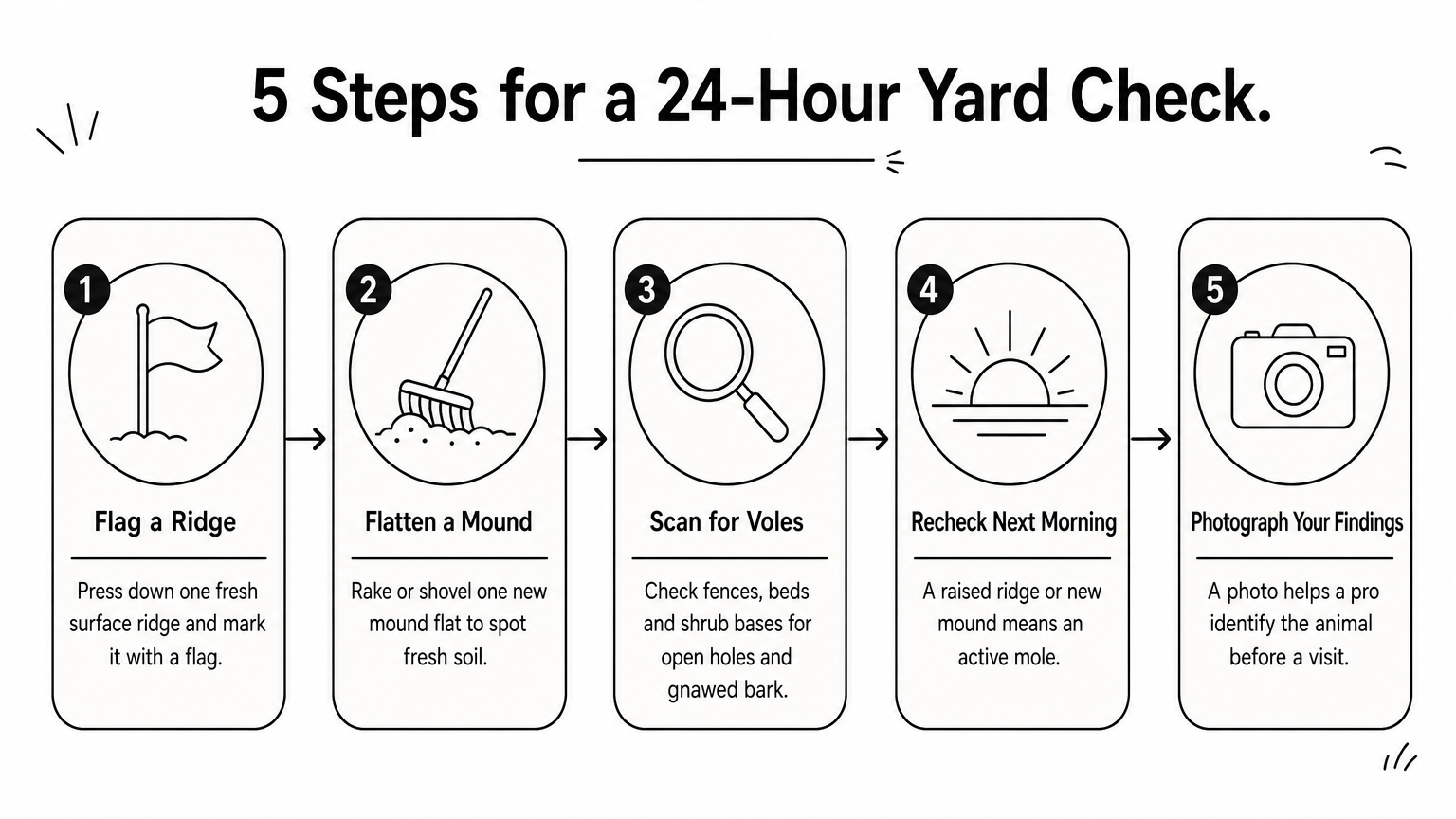
- Walk the lawn and press down one fresh surface ridge with your foot. Mark the spot with a flag.
- Rake or shovel one new mound flat so you can spot fresh soil later.
- Look along fence lines, flower beds and the base of shrubs for open holes and gnawed bark.
- Check again the next morning. A ridge raised again or a new mound means an active mole.
- Photograph what you find. A photo helps a pro identify the animal before a visit.
Stomping a ridge will not drive a mole away, but it is a useful test and costs nothing. Moles repair active tunnels quickly, while abandoned ones stay flat.
A flattened ridge that stays flat tells you more than any product label can.
Step 2. Pick control methods that work
Most store-shelf remedies fail on moles, and the methods that do work differ between the two animals. For moles, trapping with legal underground devices is the dependable option. For voles, removing cover and trapping above ground works best.
Match the method to the animal
This table sets the common methods side by side.
| Method | Moles | Voles |
|---|---|---|
| Repellents, including castor oil | No repellent reliably protects lawns, per WDFW | Mixed at best |
| Vibrating stakes, ultrasonic devices, pinwheels | Not effective in Washington | Not a dependable fix |
| Grub and insecticide treatments | Costly, slow, and moles eat more than grubs | Not relevant |
| Poison baits | Ineffective, since moles eat worms and insects | Can work, but risk pets and wildlife |
| Gas cartridges and smoke | Unreliable, because moles seal tunnels in seconds | Not suited |
| Flooding | Only for brand-new invaders, and a risk near foundations | Not suited |
| Legal underground devices | The most dependable option | Not applicable |
| Snap traps along runways | Not applicable | Effective |
| Cutting cover and guarding trunks | Little effect | Strong effect |
Mole tactics worth your time
Moles are territorial, so removing one can clear a yard for a while. Others will move in later if the habitat stays attractive, which is why long-term control takes commitment . Concentrate your effort in late winter and early spring , before females give birth.
If you try it yourself, use only devices that are legal under Initiative 713. Flooding can evict a mole that has just arrived, but pour five-gallon buckets rather than running a hose. Do not try it near a building, because water can reach the foundation or crawl space.
Vole tactics worth your time
Voles are easier to handle with ordinary tools. Cut tall grass short, since voles nest in dense, tall vegetation. Then place snap traps along the worn runways , covered with a box or board so pets and birds cannot reach them.

So, does mole killer work on voles? Not reliably. A bait built to look like worms or grubs does not appeal to a plant eater, and rodent poisons put dogs, cats and wildlife at risk. Read the product label to see which animal it is registered for.
Choose the method for the animal you confirmed, not the one printed on the biggest bag at the store.
Step 3. Hire a local pro and budget for it
A local pro is worth hiring when mounds keep coming back after a few weeks of your own effort, or when the property is large. A mole job in the Puget Sound area typically runs a few hundred dollars. Always get an estimate before work begins.
What mole control costs in the Puget Sound area
Our In/Out Mole Control service uses a free "Up-To" estimate , which is the most you would pay. The price is based on our average client's invoice for a property of half an acre or less on a five-visit weekly system.
| Item | Detail |
|---|---|
| Maximum quote | Up to $395 |
| Average client spend | $345 |
| Visits | Five weekly check-ups |
| Early finish | Sliding-scale discount if we can pull out early |
| Extra charges | None per mole caught |
| Sales tax | Not included |
| Price pages last updated | 9/1/23 |
Here is a worked example. A homeowner in Issaquah with a half-acre lot books the standard five-visit service. The most they would pay is $395 plus sales tax, which works out to $79 per visit at most. If the moles are gone sooner, the final cost drops. At the average spend of $345, the cost works out to $69 per visit. Larger properties, harder-to-reach areas or different service areas can change the estimate, so confirm your own figure with an estimate. You can call the office at (253) 926-0402 or email molemasters@gmail.com. We are open Monday to Thursday 9am to 5pm and Friday 9am to 3pm.
Questions to ask before you hire
Ask every company the same questions, and compare the answers:
- Is the company licensed and insured ?
- What devices will it use, and are they legal under Washington law?
- Does it use poisons or chemicals? Where will devices sit, and how are they protected from pets and children?
- Is the quote a maximum or a flat price, and what happens if the job needs extra visits?
- Does the service include molehill cleanup or lawn repair?
- Does the company treat voles, or only moles?
Check reviews on Google, Yelp and Facebook as well. For us, the answers are licensed and insured, no poisons or chemicals, devices under hard plastic covers and staked down, and no cleanup or lawn repair in general. We focus only on moles . If your check in Step 1 points to voles, call a general pest control company for that part of the job.
A good quote tells you the maximum price, the number of visits and exactly what is and is not included.
Step 4. Monitor, repair and prevent a return
Once the animals are gone, monitor the yard weekly for fresh signs and repair the visible damage. Other moles will eventually move in if conditions stay attractive, so follow-up is part of the fix, not an extra.
Monitor and repair the lawn
Rake or shovel all existing mounds flat so any fresh mound stands out immediately. Flatten surface ridges with your foot. Fill sunken runs with sand or screened soil and reseed, and spread grass seed over bare areas during the rainy months, which in Seattle gives seed plenty of moisture. Reset your flags weekly and note where new activity appears.
Neighbors matter too. Moles can work a tunnel system that spans several hundred feet and crosses property lines. If your property borders an area that has long held moles, expect reinvasion. We recommend year-round service if maintenance is needed for longer than eight months, but we do not usually recommend starting with it.
Make the yard less inviting to voles
Keep grass mowed short through fall, because voles favor tall, dense cover. Pull mulch back a few inches from tree and shrub trunks and clear brush piles and dense ground cover near the house. Wrap young trunks with hardware-cloth guards so a vole cannot reach the bark. Keep snap traps along the main runways until the grass stays undisturbed for several weeks.
Prevention is a weekly five-minute walk, and it catches a new problem while it is still small.
Where to go from here
Vole mole control works when you identify the animal first, match the method to it, and keep watching the yard afterward. Moles respond to legal underground trapping, ideally in late winter and early spring. Voles respond to shorter grass, guarded trunks and snap traps. Repellents, scare devices, gas and poison rarely deliver for either.
If your 24-hour check shows moles and you want them gone with no poisons or chemicals, request a free estimate from Mole Masters. You will get an upfront maximum price, a licensed and insured technician, and a plan fitted to your yard. If it turns out to be voles, start with the cover and trap steps above, and bring in a general pest company if they persist.