

Are Mole Traps Legal? What Is Banned and What Still Works
Are mole traps legal in Seattle? Not the traditional ones. Washington's Initiative 713, passed in 2000, bans the use of scissor-type and harpoon-type mole traps anywhere in the state, including on your own lawn. You can still deal with moles, but you have to pick a method that the law allows.
The reason is the wording of the law. Initiative 713 prohibits body-gripping traps, which are devices that hold, pierce, grasp or pinch an animal's body. Mole traps fit that description, so they were swept in. This article explains why the ban exists, what it covers, which options stay legal in King and Pierce counties, and how to hire help without putting yourself at risk.
Mole Masters has done nothing but mole control around Seattle and Tacoma since 1991. Here is the straight answer.
Why mole trap laws matter to your yard
Mole trap laws matter because the most common do-it-yourself fix is the one the state prohibits, and the person who sets the trap carries the legal risk, not the store that sold it.
The short answer for Seattle-area homeowners
State law applies the same way in Seattle, Issaquah, Puyallup, Gig Harbor and every other city in King and Pierce counties. The Washington Department of Fish and Wildlife (WDFW) says that, because of their body-gripping design, traditionally used mole traps are no longer legal for use in Washington. It adds that there are no exceptions for emergencies and no way to get verbal approval or a special permit.
Moles themselves are unclassified. Under RCW 77.36.030, you may kill them on your own property when they damage your property. The right to act is not the problem. The choice of device is.
You may control moles on your own land, but you may not use the scissor or harpoon traps most people think of first.
Buying is a separate matter from using. State officials have said that owning or selling these traps remains legal and only their use is banned. A trap on a store shelf or in an online listing therefore tells you nothing about whether you may set it. City ordinances can add limits of their own, such as rules on discharging firearms.
Why Washington banned body-gripping traps
Voters passed Initiative 713 in the 2000 election, and it took effect on December 7, 2000. It was sold chiefly as a measure against traps that accidentally kill pets and maim wildlife. Moles were not the campaign's focus.
Mole traps got caught by the drafting. The law exempted common rat and mouse traps but did not exempt mole traps. The state Attorney General's office later concluded that the two common mole trap designs, the scissor type and the spearing type, are body-gripping traps. Its 2002 analysis reads the ban to cover any trap other than a common rat or mouse trap that holds, pierces, grasps or pinches a body part.
What breaking the rule can cost you
Enforcement has been real, though uneven. In 2007 the Seattle P-I reported that wildlife officers investigated two Kenmore mole removal companies after a competitor complained. One operator had been warned in 2004 and fined $609 in 2006 for using the traps and failing to register as a trapper. An enforcement captain said the ban was a low priority but that officers act on complaints.
That history is old, and you should not read it as a promise of leniency. If you hire a trapper who uses banned devices, you are paying for a method the state says is unlawful.
What counts as a banned mole trap
A banned mole trap is any trap that grips, spears, pinches or holds the animal's body, which covers the scissor-type and harpoon-type traps sold as mole traps in most garden stores.
How the state defines a body-gripping trap
The scissor trap is usually built from two U-shaped jaws joined by a hinge. You set the points of each "U" on either side of a tunnel. When the animal trips the trigger against the tunnel wall, the jaws snap shut. The spearing type works on the same principle with spikes. Both fall under the ban, according to the Attorney General's reading.
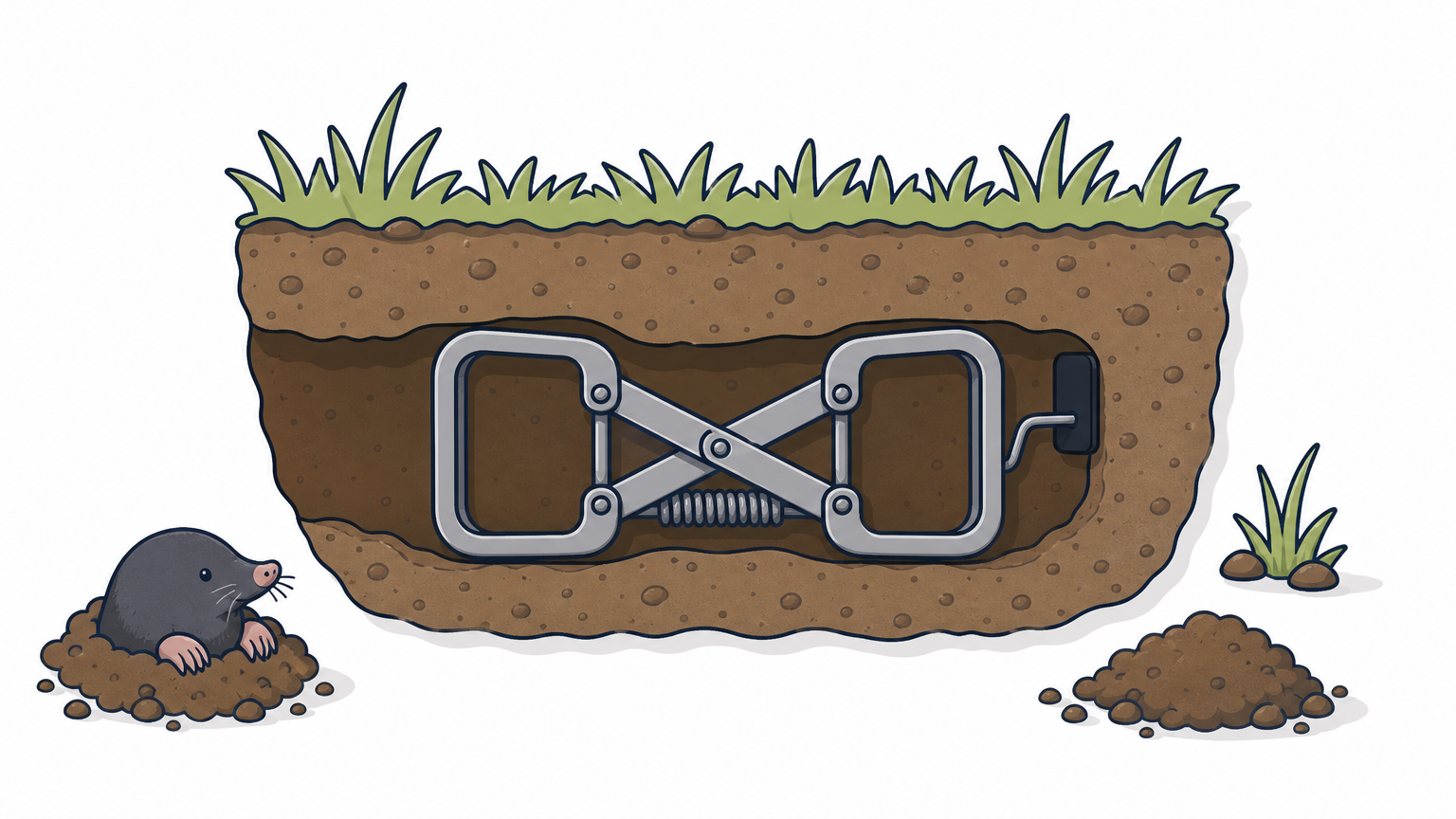
The test is how the device works, not what you call it. A trap marketed as "humane," "professional grade" or "for gardeners" is still body-gripping if it grips or pierces the animal. Check the mechanism, not the label.
If a trap closes on the animal's body or spears it, assume the state treats it as banned for use.
Which traps and tools are still allowed
This table sets the main device types side by side. It reflects the state's published position, so confirm any edge case with WDFW before you act.
| Device | Status for use in Washington | Notes |
|---|---|---|
| Scissor-type mole trap | Banned | Body-gripping design, covered by RCW 77.15.192 and 77.15.194 |
| Harpoon or spear-type mole trap | Banned | Identified by the Attorney General's office as body-gripping |
| Common rat and mouse trap | Exempt from the ban | Sold for rodents, not built for mole tunnels |
| Non-gripping trap, such as a buried pitfall container | Outside the body-gripping definition | Uncommon for moles, so check with WDFW first |
| Buying or owning a banned mole trap | Treated as legal | Using it is the offense |
Do the rules apply on your own property?
Yes. The property-owner right in RCW 77.36.030 covers your decision to control moles, not the device you pick. WDFW states plainly that there is no special permit for a homeowner who wants to use a traditional mole trap.
Be careful with advice from forums and older posts. Many homeowners say they "set traps for years," and the rules differ in other states. A neighbor who got away with it did not make the method lawful. Check the current statute and the WDFW page, or call a licensed operator who works in this area.
How to handle moles legally in your yard
Start by confirming the animal is a mole, then work through tolerance, timing and the legal control methods, and bring in a professional once the tunnel system is established.
Confirm it is a mole before you act
Mole mounds are roughly circular, 6 to 24 inches wide and 2 to 8 inches high, with a plugged opening near the center. Pocket gophers tend to push up fan-shaped mounds with the plug off to one side. Voles use mole tunnels but do not build mounds.

Identification matters because control methods differ for each animal, and some pocket gophers in Washington are state-listed. Getting it wrong can mean doing the wrong thing to the wrong animal.
Ask yourself whether the mole is a real problem. Moles eat cranefly larvae and slugs and aerate the soil. WDFW notes that a typical city lot rarely holds more than one male or two females, so the damage you see may come from a single animal. If the damage is minor, tolerance costs the least.
Steps that stay within the law
These steps use methods that WDFW and WSU Extension describe as lawful. They work best on a new or small problem.
- Level mounds as they appear. Shovel or rake the soil flat, and flatten ridges with your foot. Fresh mounds then stand out, so you can see when activity returns. Reseed bare patches during the rainy months.
- Pick your timing. Moles dig most in fall and winter, when the soil is moist. WDFW recommends concentrating control in late winter and early spring, before the young are born.
- Use a shovel on a fresh surface tunnel. Moles are sensitive to concussion, and a hard shovel strike on an active ridge often kills one quickly. It takes patience and luck.
- Try flooding only on a new invasion. Pour five-gallon buckets into the tunnel quickly, since a hose is too slow. Keep well away from foundations, because flooded basements and crawl spaces are a known side effect.
- Treat gas cartridges as a long shot. Moles seal their burrows within seconds. If you try one, read the label, place it in a main tunnel on a recent invasion, and wet the soil first.
- Call a professional when the problem is established. A mature tunnel system can run for hundreds of feet, so do-it-yourself methods rarely catch up.
What to skip
Skip repellents and scare devices. WDFW says no repellent reliably protects a lawn, and frightening devices such as vibrating stakes and ultrasonic units have not proven effective in Washington. Mothballs, garlic and human hair fare no better. Moles often leave one stretch of tunnel and return later, which makes a repellent look like it worked.
Skip poison baits and homemade fixes as well. WDFW says poisoned baits have proven ineffective on moles, and WSU Extension reported no control from the baits it tested. It also warns that applying unregistered materials as pesticides is illegal. That covers chewing gum, laxatives, drain cleaner and car exhaust. Soil insecticides are costly and risk harming groundwater and beneficial soil life. Firearms are illegal to discharge in many areas and too hazardous in populated ones.
Most "legal" home remedies are legal because they do not work, so spend your effort on timing and professional help.
How to hire a mole controller who follows the law
Hire someone who can name their method in plain terms, show a license and insurance, and give you a written estimate with a ceiling price.
Questions to ask before you hire
Put these to every company, including us:
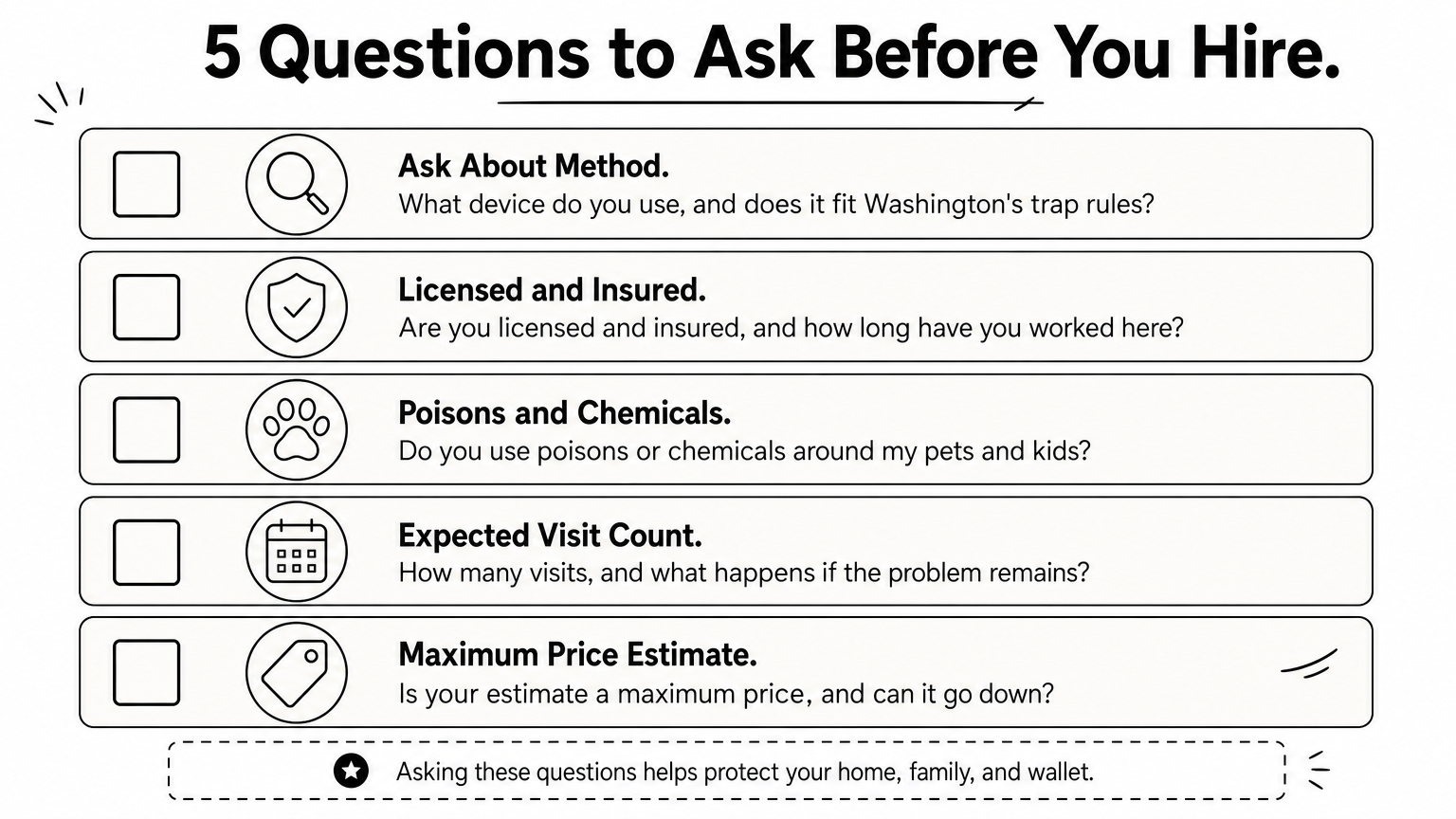
- What device or method do you use, and how does it fit Washington's body-gripping trap rules?
- Are you licensed and insured, and for how long have you worked in this area?
- Do you use poisons or chemicals around my pets and kids?
- How many visits should I expect, and what happens if the problem is not solved by then?
- Is your estimate a maximum price, and can it go down?
A company that openly says it sets scissor or harpoon traps is describing a method the state says cannot be used. Treat that as a reason to look elsewhere. Promises of a one-visit fix on an established yard deserve the same caution.
What professional control costs
Mole Masters has done only mole control since 1991 and uses underground devices with no poisons or chemicals. We stake our devices down under hard plastic covers. Ask us about method too when you call.
Our In/Out Mole Control is quoted as an "Up-To" price of $395, based on a half-acre or smaller property and five weekly visits. Our average client spends $345, and the price does not include sales tax. Spread over five visits, that works out to about $69 per visit on average and $79 at the ceiling. Larger or harder properties can change the estimate. If we can pull out early, you get a discount on a sliding scale, and we do not charge extra per mole caught.
We do not generally clean up molehills or repair lawns, so levelling mounds from the steps above stays on your list.
What to do next
Traditional scissor and harpoon mole traps are banned for use in Washington, and no emergency exception or homeowner permit exists. Owning one is not the offense, but setting one is. You still have lawful options: confirm the animal, tolerate minor damage, time your effort for late winter, and use a shovel or flooding on a new invasion.
When the tunnels are established, a licensed professional is the practical route. If you are in King or Pierce County and want a fixed ceiling price before you commit, request a free mole control estimate by form, phone or email. We will explain exactly what we do in your yard.