

Most Effective Mole Control Method: Trapping, Step by Step
The most effective mole control method is trapping. A mole-specific trap set in an active, straight tunnel removes the animal itself, which no repellent, grub treatment or home remedy does reliably. Worm-shaped poison bait is a distant second, and most of the other products on the hardware store shelf waste your money. This guide shows you how to find the right tunnel, set the trap and confirm the mole is gone.
You probably know the problem already. Fresh ridges cross the lawn, mounds appear overnight, and the grass above the tunnels turns brown as its roots dry out. A mole can eat 70 to 80 percent of its body weight in a day and it never stops tunneling, so every week of guessing costs you more lawn. Meanwhile the store aisle sells ultrasonic stakes, gum and "rodent and mole" baits that moles simply ignore.
At Mole Masters, we have done nothing but mole control in the Puget Sound region since 1991, so the advice below comes from real yards. First you will see how the methods compare. Then come four steps: find the active runs, set the trap, check and move it, and keep new moles out. We also cover when it makes sense to hand the job to a professional.
Why trapping beats bait and repellents
Trapping is the most effective way to get rid of moles because it is the only method that physically removes the animal from your lawn. University extension specialists reach the same conclusion: trapping is challenging, but it is the most successful and practical option. Every other method depends on the mole eating something it does not want or choosing to leave on its own.
How the main methods compare
The table below sets each common approach side by side, so you can see why trapping comes out on top.
| Method | How it works | How well it works | Main drawback |
|---|---|---|---|
| Kill trap in an active run | Spring trap sprung by the mole itself | Most reliable option | Needs correct placement and patience |
| Worm-shaped bait (bromethalin, such as Tomcat Mole Killer) | Mole eats a lure dropped into the run | Sources disagree, and research against trapping is thin | Poison you must handle, with risk to pets and wildlife |
| Gel bait (warfarin) | Injected into runs with a syringe | Little proof of value | Same poison concerns |
| Castor oil repellent | Makes soil unpleasant | May reduce damage in some cases | Discourages, does not remove |
| Grub control | Cuts one food source | Poor on its own | Earthworms remain the main food |
| Gas cartridges | Fumes fill the tunnel | Not generally recommended | Tunnels are too long and porous |
| Gum, hair, mothballs, pinwheels, ultrasonic stakes | Supposed to scare moles off | No research support | Lets damage continue |
Read the table as a ranking. Trapping sits alone at the top. Bait is the only other approach that kills moles, and since sources disagree on how well it performs, treat it as a fallback.
Trapping removes the mole, while every other method asks the mole to cooperate.
Why bait, repellents and grub control fall short
Moles are not rodents, so grain, seed and pellet baits made for rats and mice do nothing. Their main food is earthworms. That is why grub killers fail as a mole fix, since even grub-free lawns hold moles. Killing soil insects can also make a mole dig more while it hunts farther for food.
Repellents deserve a fair word. Castor oil products may cut damage under some conditions, and flooding a tunnel can push a mole out for a while. Neither removes the animal. Gum, human hair, razor blades and pinwheels have no research behind them, and I would not expect vinegar poured into tunnels to do any better.
Quick answers to common questions
Searchers keep asking the same few things, so here are direct answers.
- Best deterrent: a castor oil repellent is the most credible option, but it only discourages moles.
- What kills moles permanently: a trap removes the individual mole. Whether the yard stays clear depends on keeping the habitat unattractive, because neighbors move into vacant ground.
- What golf courses and farms use: the same short list of trapping and labeled bait. Extension specialists note that eliminating moles over large areas is difficult, if not impossible.
- How fast it works: a well-placed trap often catches the mole within a day or two. If it does not, you move it (Step 3).
Step 1. Find the active runs
Start by finding the tunnels a mole still uses, because a trap in an abandoned run catches nothing. This takes two days and costs nothing.
Confirm that moles caused the damage
Moles leave two signs. Raised surface ridges are unique to moles, and cone-shaped molehills of coarse soil mark deep tunnels or nest chambers. Pocket gophers leave many mounds of fine, sifted soil and no ridges. They need different traps, so identify the animal before you buy anything. Voles and shrews also borrow mole tunnels, so a tunnel alone does not prove a mole is in it.
Run the stomp test
Not every ridge is in use. Many are one-time feeding tunnels that the mole never visits again. This test separates busy runs from dead ones.
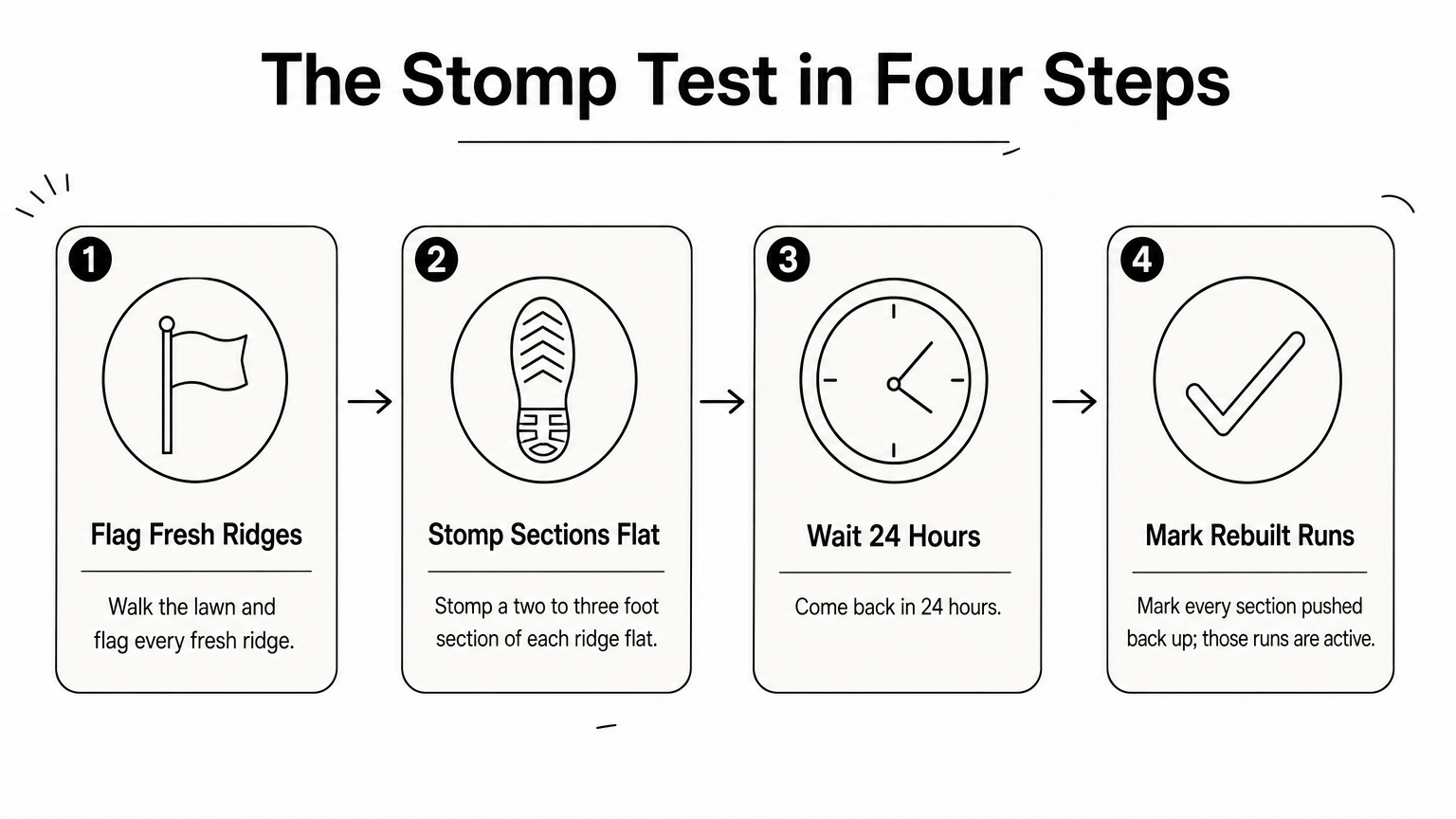
- Walk the lawn and flag every fresh ridge.
- Stomp a two to three foot section of each ridge flat.
- Come back in 24 hours.
- Mark every section that has been pushed back up. Those runs are active.
Straight runs are your targets. Straight tunnels that follow a curb, driveway edge, fence or foundation usually connect the nest to the feeding area, so a mole travels them again and again. Twisting ridges in open lawn are mostly foraging tunnels. Ignore them.
A trap belongs in a straight run that the mole rebuilt after you flattened it.
Timing matters too. When the ground dries out in summer or freezes in winter, earthworms and moles move deeper and surface ridges stop appearing. A quiet lawn in August does not prove the moles are gone, so begin trapping when ridges are fresh.
Step 2. Choose and set your trap
Use a mole-specific kill trap, match it to the depth of the run, and set it on firmly packed soil. A trap works because of the mole's own habit of repairing blocked tunnels.
Pick the right trap type
Three designs have a long record on moles. They all use a broad trigger pan that the mole pushes up as it reopens the tunnel.
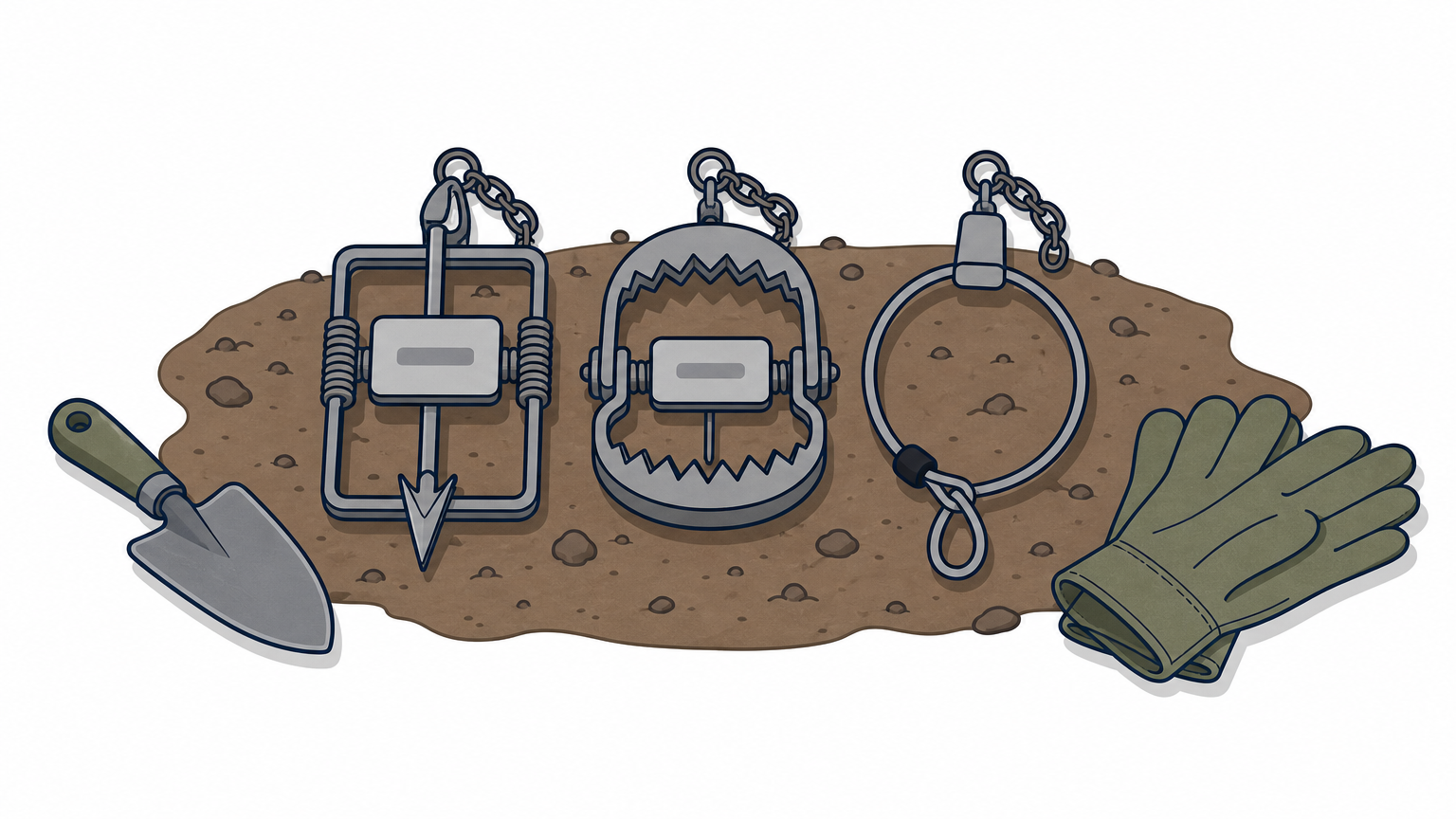
| Trap | How it kills | Best for | Setup effort |
|---|---|---|---|
| Harpoon | Spring drives spikes into the run | Shallow runs near the surface | Lowest |
| Scissor-jaw | Jaws close across the run on both sides of the trigger | Deeper runs | Medium |
| Choker loop | Loop tightens around the mole | Straight runs where you can dig a cross hole | Highest |
Buy traps at a hardware, home repair or farm supply store. They often sit in the same aisle as products that do not work, so check that the package says mole trap, not "repeller" or "rodent and mole bait."
Set the trap in six steps
Placement and a clean setup decide whether the mole walks into it or avoids it.
- Pick a straight run with fresh work in it, never a twisting ridge and never the top of a molehill.
- Dig out a short section of the burrow so you can see the tunnel line.
- Replace loose, damp soil and pack it firmly where the trigger pan will rest.
- Set the trap according to its design and give it a hair trigger, so it springs easily.
- Position the trap so the mole must pass through the jaws, spikes or loop. Fill around a buried trap with loose soil so no light enters the tunnel.
- Release the safety catch last, and keep your feet off the nearby runs.
Handle every trap as the dangerous tool it is. Keep children and pets away from the lawn while traps are set, and wear gloves.
The trap works when the mole springs it while repairing what looks like a collapsed tunnel.
Start with two or three traps on your busiest straight runs. Moles are solitary, so most yards hold only one or two animals, and more traps just means more places to check.
Step 3. Check, move and confirm the kill
Check each trap once or twice a day, move any trap that has caught nothing in two days, and call the job done only after a week without new ridges.
Use the two-day rule
A trap that sits empty for two days is in the wrong place. Pull it and reset it on another active run. Three causes explain most failures:
- The mole changed its habits and stopped using that run.
- You disturbed the run too much while setting up.
- The trap was set badly and the mole sensed it.
When you move a trap, repeat the stomp test on the new run first. A trap on a fresh, proven run beats a trap left to wait on a tired one.
Confirm the mole is gone
After a catch, flatten every remaining ridge and watch the lawn for seven days. If ridges rebuild, another mole has taken over the territory, so reset your traps. Do not read quiet as success, since moles also go deep in dry or frozen ground. Spring deserves extra attention. Moles breed in late winter and spring, litters of two to five arrive from March to May, and the young leave the nest at about four weeks.
Wear gloves when you handle a dead mole and seal it in a bag before disposal. This schedule shows a realistic two-week routine:
| Day | What you do |
|---|---|
| 1 | Flag ridges and stomp them flat |
| 2 | Read the results and set traps on rebuilt, straight runs |
| 3 to 4 | Check daily and move any trap that has sat empty for two days |
| After a catch | Flatten all ridges and watch for seven days |
| Day 14 | If no ridges have returned, pull the traps and fill the low spots |
Judge success by seven quiet days after the catch, not by one empty trap.
Step 4. Keep new moles from moving in
Expect new moles to move into good habitat, so reduce what draws them and know when to hand the job to a professional. Extension specialists note that many residential yards stay mole-free for years once the resident animal is removed, but only if nothing invites the next one.
Make the yard less inviting
Moles prefer moist, sandy loam and tend to avoid heavy, dry clay. Packing the soil with a roller and cutting back overwatering can make a lawn less attractive to them. A castor oil repellent can add a little protection around the edges, but treat it as a supplement to trapping.

Grub control is the one to be careful with. Mid-June to mid-July is the window for treating white grubs, and only if you have confirmed grubs in the turf. Spring grub treatments are not justified. Even a perfect treatment will not remove earthworms, the main food, so do not count on it to clear moles.
Know when to call a professional
Call a professional when you have moved traps through several two-day cycles with no catch, when the property is large, or when moles keep coming back. Many Mole Masters customers have already tried store products, poison or bait before they call us. We control moles with underground devices, no poisons or chemicals, and the devices are covered with hard plastic and staked down.
Our In/Out Mole Control is a five-visit weekly system, and we give a free "Up-To" estimate that shows the most you could pay.
- Up to $395 for a property of a half acre or less, before sales tax, with an average client spend of $345.
- A discount on a sliding scale if we can pull out early.
- No extra charge per mole caught.
A worked example for a half-acre lawn: the $395 cap across five weekly visits works out to $79 a visit at most. A client who pays the average of $345 spends $50 less than the cap. Larger or harder properties can change the estimate. If you need maintenance for longer than eight months, we recommend our year-round program.
A professional is worth the call when your own traps have failed twice or the lot is too big to cover.
Trap first, then decide
Trapping is the most effective mole control method because it removes the mole, while bait, repellents and grub control depend on the mole's cooperation. Find active straight runs with the stomp test, set a matched trap on packed soil, move it after two empty days, and watch for a full week before you call the lawn clear. Then make the yard less inviting so the next mole has less reason to move in.
If your traps keep coming up empty, or you would rather not handle them, you do not have to keep guessing. Request a free Up-To estimate from Mole Masters by form, email or phone, and we will tell you what your yard needs.