

Which Are the Best Mole Traps? 5 Types Ranked and Compared
If you are asking which are the best mole traps , the short answer is a tunnel-style trap for most lawns. It kills fast, shuts out light and rarely jams. A soil-triggered trap such as the Talpex or Victor Out O'Sight suits moles that keep dodging other traps. A well-made scissor-jaw trap suits a beginner with a single mole. Whatever the type, a good trap sits in an active run and kills quickly.
The hard part is that traps look alike on a shelf. Many cheap imports have thin wire and poor design, and a trap that nips a mole without killing it teaches that mole to avoid the next one. You can spend $20 and still wake up to fresh mounds.
This list ranks five trap types by catch reliability, ease of setting, and where each one fails. Mole Masters has done nothing but mole control around Seattle and Tacoma since 1991, and many of our customers call after trying store-bought products first. After the list you get a side-by-side table, sizing and setting tips, a worked cost example, and the point where hiring help makes more sense than buying another trap.
1. Tunnel traps, also called Duffus traps
How it works
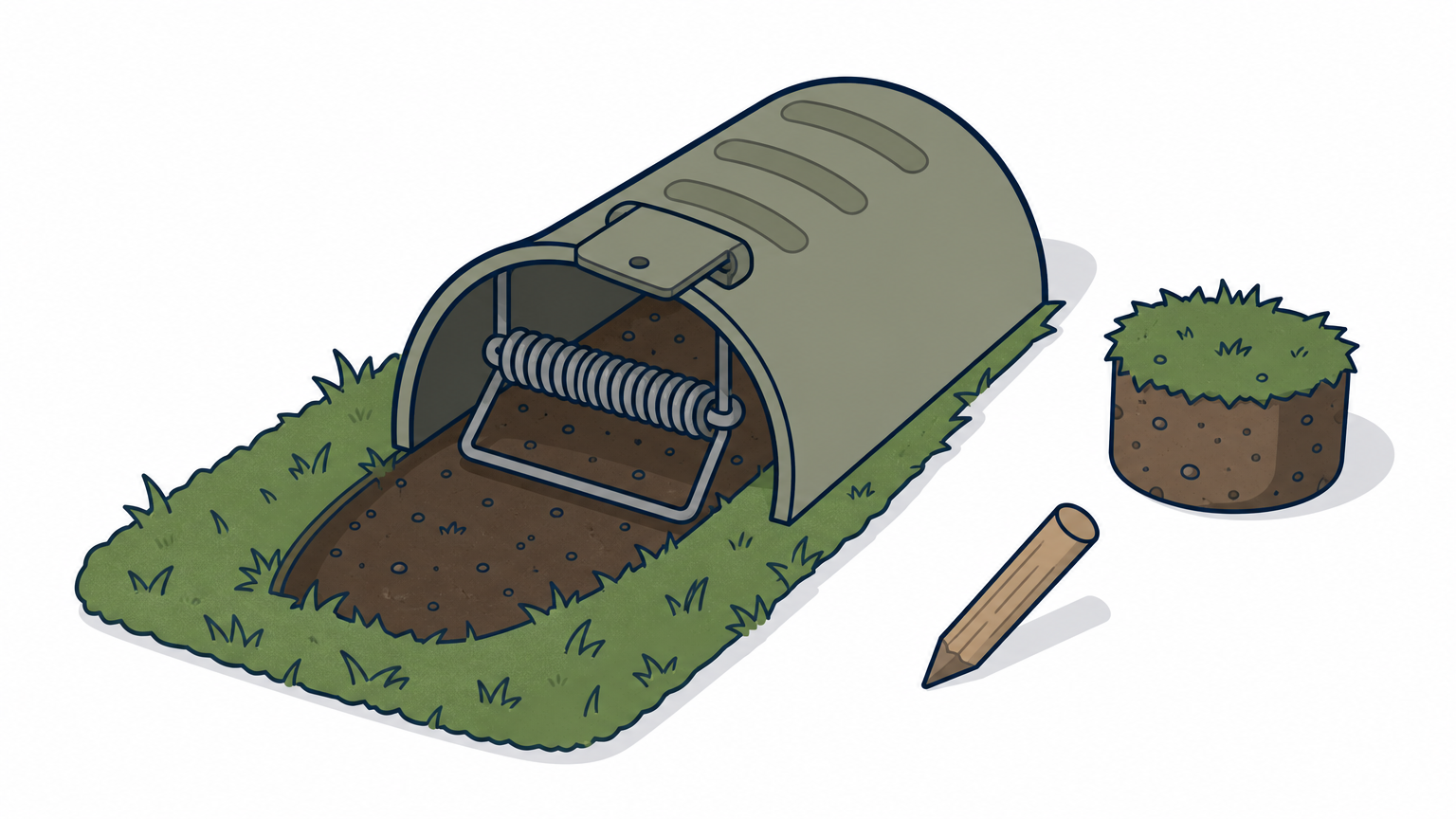
A tunnel trap is a half tunnel with a strong spring and a trigger inside. You open a short stretch of an active run and set the trap in it. The mole triggers it as it pushes through. The half tunnel works as a roof, so a little loose soil or a small board over the top is enough to shut out light . The moving parts also stay clear of stones and turf.
That design is why it ranks first and why most professional mole catchers choose it . One catcher with 50 years in the trade reports that over 80 percent of tunnel traps a mole had passed held a catch, against about 50 percent for scissor traps. That is one person's tally, not a controlled test, but the design logic backs it up. Rain does not wash it open, and it works in deep and shallow runs alike.
A trap that blocks light and resists jamming catches more moles than one that is merely easy to set.
Pros and cons
- Pros: fast, powerful kill. It copes with deep and shallow runs. Rain and stones barely affect it. It leaves a lawn neater, because you can cut out a turf plug, set the trap and replace the turf afterward.
- Cons: it takes practice to set, and a slip can snap on your fingers. Most need "tuning" so they trigger lightly. Nothing shows above ground, so mark the spot with a stake or you may lose the trap.
- Watch out: some popular brands have design flaws, and cheap copies are worse.
Who it suits
Pick this if you have persistent moles or several runs and you will invest an hour learning to set it. Good single traps usually cost about $10 to $25 from specialty sellers. Look for thick wire, a firm spring, a recognizable maker and a setting video.
2. Soil-triggered traps like Talpex and Out O'Sight
How it works
These traps release when the mole pushes soil to repair the tunnel. It never has to touch a trigger with its nose or flipper. That makes them the best answer for a trap-shy mole that keeps plugging or dodging a tunnel trap. The original Talpex comes from the Netherlands and has its name on the trigger plate, and the Victor Out O'Sight is an American design built on the same idea.
Both have a very strong spring. The Victor is large and heavy, and you need its setting handles to arm it. Squeezing the handles by hand is nearly impossible. If you use one, keep your fingers clear and read the instructions twice.
When a mole ignores a tunnel trap, a soil-triggered trap is the next thing to try.
Pros and cons
- Pros: works on wary moles. It needs little adjustment before use, and the kill is powerful.
- Cons: stones can lodge in the jaws, and it is poor in very shallow runs. Installing it takes time in stony ground. Many Talpex copies are bad.
Who it suits
Choose a soil-triggered trap when tunnel traps have failed and your soil digs clean, without rocks. If you hit stones every few inches, the jaws will fight you. The Victor is easy to find in the US, but check the branding on the plate before you pay for a lookalike.
3. Scissor-jaw traps
How it works
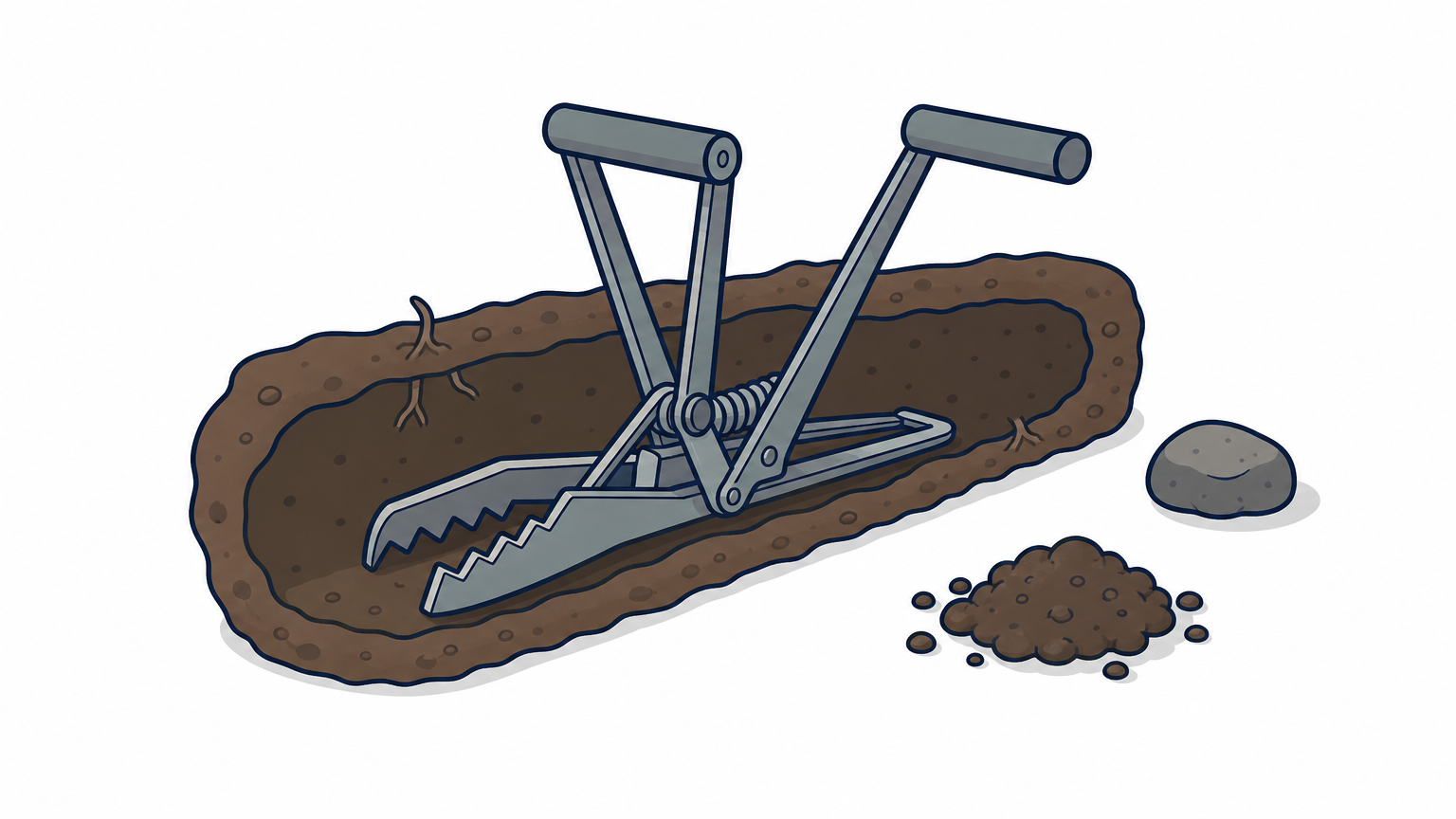
The scissor-jaw trap is the one in most garden centers. You squeeze the handles, set the trigger tongue and push the trap into the run. When the mole pushes the trigger, two jaws close on it like scissors. It is simple, sturdy and easy to set, and you can see from a distance whether it has sprung. Polaflex traps use galvanized steel that resists rust, which matters in a wet climate.
The problems start after installation. The handles stick up, so it is hard to block light fully without fouling the jaws. A stone in the wrong place jams the action. Heavy rain can wash the cover soil off, and a mower will destroy one. Every miss risks a trap-shy mole, and that is why this type ranks third.
Easy to set does not mean easy to catch with, because the trap's weak points show up once it is in the ground.
Pros and cons
- Pros: cheap, easy to set, visible when sprung, simple design.
- Cons: lower catch rate, jams on stones, hard to cover well, unsafe where livestock or mowers pass.
Who it suits
It fits a homeowner with one or two moles who wants something quick. Budget around $15 for a solid single trap and skip unbranded multipacks, since flimsy springs and thin metal cause many of the misses. Check it often for jamming.
4. Harpoon traps
How it works
A harpoon trap sits over a flattened section of run with its trigger pressed against the soil. When the mole pushes up to repair the tunnel, spring-loaded spikes drive down into the run. It is cheap, easy to place and needs no digging, so it sells well in big-box stores.
Results are inconsistent. The trap sits on the surface, so light and air reach the run and moles often dig around or under it . The spikes are also a hazard for pets, children and anyone mowing. Many people who call us have tried in-store products first.
Harpoon traps are the cheapest option on the shelf, and they cost the most in wasted weeks.
Pros and cons
- Pros: lowest price, quick to place, no digging.
- Cons: exposed on the surface, inconsistent catches, a safety risk, and moles can bypass it.
Who it suits
It suits a low-stakes situation, such as one stray mole in a fenced yard with no pets or kids. If you try one, check it every day and move on to a tunnel or soil-triggered trap if nothing happens within a few days.
5. Live-catch traps
How it works
A live-catch trap is a tube with a one-way swinging door at each end, set in an active run. A mole walks in and cannot back out. The idea appeals to anyone who does not want to kill the animal. In practice the mole often digs around the tube, and one experienced catcher reports never catching anything in his half dozen tries.
You also have to check it at least once a day , and more often is better. A mole left in the tube without food suffers, so the humane label only holds if you are strict about checking. Releasing wildlife is regulated in many places, and a mole moved elsewhere often does not survive. Another mole usually moves into the empty tunnels.
A live-catch trap is humane only if you check it daily, and it rarely catches the mole anyway.
Pros and cons
- Pros: no kill on your property, and no spikes or jaws.
- Cons: low catch rate, strict daily checks, legal questions around release, and no lasting fix.
Who it suits
It fits a patient owner who objects to lethal traps and has time to check it. Expect disappointment, and confirm your state's rules on handling and releasing wildlife before you start.
How to choose, set and budget for a mole trap
Side-by-side comparison
Pick by your soil, your moles and your patience. This table pulls the five types together.
| Trap type | Catch reliability | Ease of setting | Weak spot | Best for |
|---|---|---|---|---|
| Tunnel (Duffus) | High | Moderate, needs tuning | Hard to find locally, hidden once set | Persistent moles, any run depth |
| Soil-triggered (Talpex, Out O'Sight) | High, even on wary moles | Hard, very strong spring | Stones, shallow runs | Trap-shy moles in stone-free soil |
| Scissor-jaw | Moderate | Easy | Jams, light leaks, rain | One or two moles |
| Harpoon | Low to moderate | Easy | Surface exposure, safety | Low-stakes cases only |
| Live-catch | Low | Easy | Daily checks, digs around | Owners who will not kill |
Skip sonic stakes, poison baits and gas cartridges. Little reliable evidence supports sonic devices. Poisons and gas put pets and wildlife at risk, and Mole Masters uses neither.
Do mole traps work, and how to set them
Mole traps work when they sit in an active run , and most failures come from placement. University extension services consistently name trapping as the most reliable control. To set one:
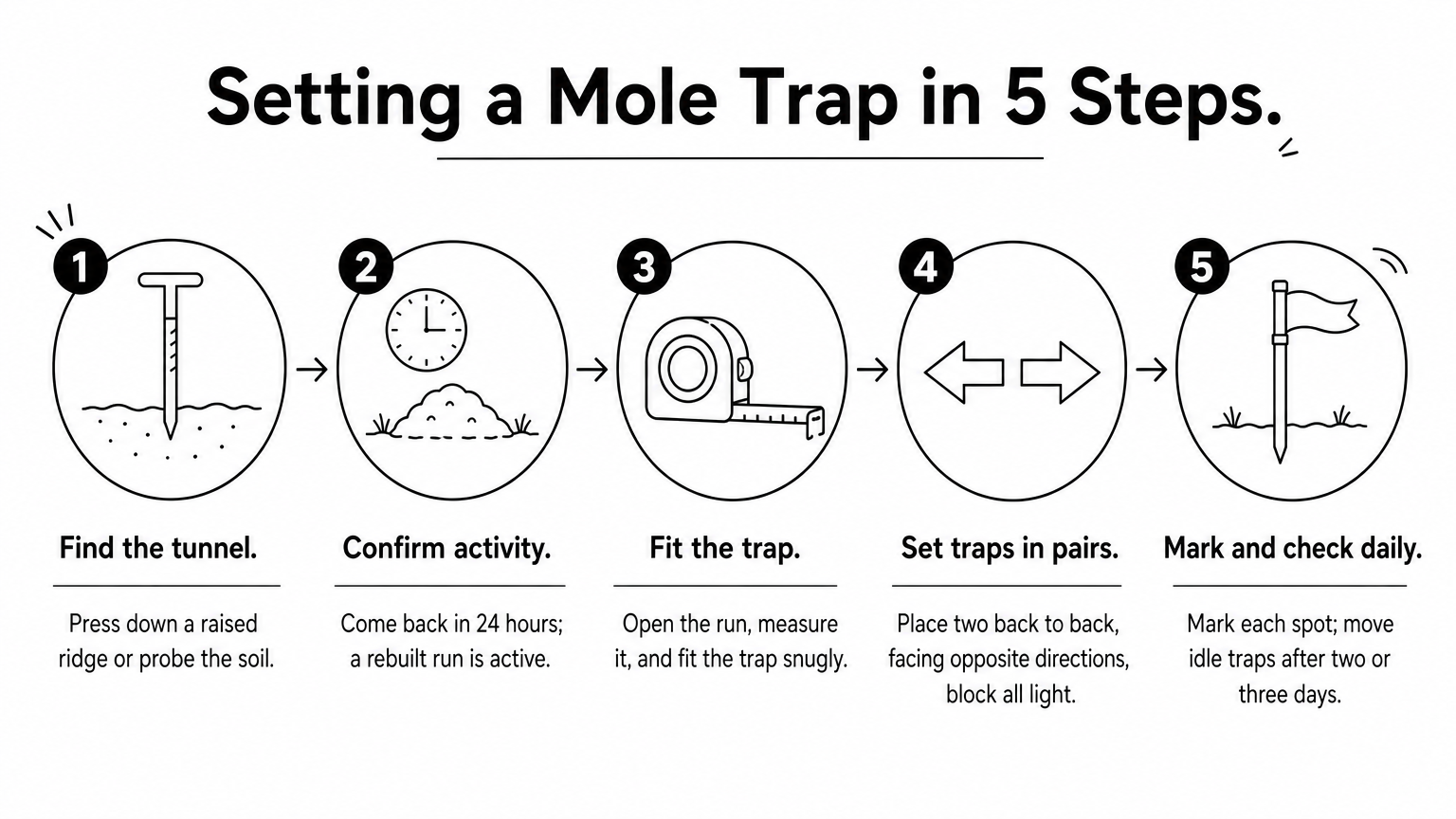
- Press down a short stretch of a raised ridge or probe the soil to find the tunnel.
- Come back in 24 hours. A run that has been rebuilt is active.
- Open the run and fit the trap snugly. As one example, a US maker sizes its traps for tunnels of about 1¼" x 1½" (small), 1⅞" to 2¼" (medium) and 3" (large). Measure your own run first.
- Set two traps back to back, facing opposite directions, and block all light.
- Mark each spot and check daily. Move a trap if nothing happens in two or three days.
Measure the tunnel, block the light and set traps in pairs, and a decent trap does its job.
Rules on lethal traps differ by state and city, so confirm yours with your state wildlife agency before you buy.
What it costs and when to hire help
Say you have three active runs. That is six traps at about $20 each, or roughly $120 . It is a low outlay, but your time is not free, and a wary mole can make the first set of traps a wasted one.
Compare that with our In/Out Mole Control. It is quoted as "Up-To" $395 for a property of half an acre or less. That covers five weekly visits, and our average client pays $345. Sales tax is extra, and larger or harder properties can change the estimate. If we can finish early, the price drops on a sliding scale, and we do not charge extra per mole caught. Estimates are free.
Call a pro when traps keep springing empty, when fresh mounds appear after two weeks of trapping, or when the property is large. Our technicians use underground devices with hard plastic covers, staked down, and no poisons or chemicals.
Pick the trap that fits your yard
The best mole trap is the one that catches in your run. For most lawns that means a tunnel trap, with a soil-triggered trap as backup for wary moles and a good scissor-jaw trap for a simple single-mole job. Harpoon and live-catch traps rank lower because of their weaker catch rates, safety risks and daily-check demands. Measure the tunnel, find an active run, block the light and buy from a recognizable maker.
If you would rather skip the trial and error, request a free estimate from Mole Masters. We will tell you what your yard needs and what the most you would pay will be before we start.